
ANA's loyalty program with fixed, published pricing and access to the full Star Alliance network. Known for excellent availability on ANA's own premium cabin flights, including one of the world's best first class products.
These cards earn transferable points that can be converted to ANA Mileage Club.
Our Valuation
2 cents per point(CAD)
1.5 cents per point (USD)
The single cheapest way to fly premium cabins to Japan on round-trip awards – 100,000 miles for business class and 150,000 for first class in low season, unmatched by any competitor. The trade-off is accessibility: no Canadian transfer partner exists, so miles must come via US Amex MR at 1:1, making this the primary reason Canadian points enthusiasts build a US credit card portfolio.
Last updated: February 12, 2026
All Nippon Airways (ANA) is one of Japan's two largest carriers and a Star Alliance member, best known for "The Suite" first class and "The Room" business class. ANA Mileage Club's zone-based, seasonal award chart delivers some of the lowest premium cabin redemption rates from any program worldwide, but it's also one of the hardest programs to feed with miles since it has very few transfer partners.
For Canadians, the Vancouver–Tokyo Narita nonstop is the primary gateway. The program underwent a major overhaul on June 24, 2025, introducing one-way awards on ANA metal for the first time while raising high-season pricing by roughly 50% — but low and regular season pricing remained unchanged, preserving the sweet spots that make this program essential for Japan-bound travellers. Here's your complete guide.
The most efficient path to earning ANA miles is through American Express US Membership Rewards, which transfers to ANA Mileage Club at a ratio of 1:1, with a minimum transfer of 1,000 points.
Transfers typically take around 48 hours to post, so they are not instant. From time to time, Amex runs 15-25% transfer bonuses to ANA, which are rare but extraordinarily valuable when they appear.
It is important to emphasize that this is Amex US Membership Rewards only. Canadian Amex Membership Rewards does not transfer to ANA Mileage Club.
For Canadians, the pathway to Amex US is Amex Global Transfer, which allows an existing Canadian Amex cardholder to open an Amex US card without a US credit history. This is widely considered the single most compelling reason for Canadian points enthusiasts to build a US credit card portfolio.
Marriott Bonvoy points can also be transferred to ANA at a ratio of 3:1, with a bonus of 5,000 miles for every 60,000 Bonvoy points transferred. In practice, this means 60,000 Bonvoy becomes 25,000 ANA miles, an effective ratio of 2.4:1 when transferring in multiples of 60,000.
While this is not an efficient way to build a large ANA balance, it can be useful for topping off an account when you're a few thousand miles short of a redemption.
Several hotel programs also transfer to ANA at poor ratios: Hilton Honors at 10:1, IHG One Rewards at 5:1, World of Hyatt at 2.5:1, and Shangri-La Circle at 1:1. None of these are recommended as primary earning methods.
Notably, ANA does not sell miles directly to members. There is no option to purchase miles through the program, which makes ANA miles relatively scarce compared to programs like United MileagePlus or American Airlines AAdvantage where you can buy miles during frequent sales.
Miles earned from flying are credited based on distance flown, cabin, and fare class. Economy fares earn 30-100% of the distance flown in miles, premium economy earns 70-100%, business class earns 70-150%, and first class earns 150%. You can use the flight mileage calculator on ANA's website to estimate your earnings for any given ticket.
As a Star Alliance member, ANA allows you to credit flights on any Star Alliance partner to your ANA Mileage Club account. ANA also partners with several non-alliance carriers, including Etihad Airways, Philippine Airlines, and Virgin Atlantic, among others. When flying with partners, simply add your ANA Mileage Club number at booking or check-in to receive credit.
In the US, the First National Bank of Omaha (FNBO) issues the ANA Card USA, a co-branded credit card intended primarily for Japanese expats. The card offers a modest 5,000-mile welcome bonus with no spend requirement and earns 1.25 miles per dollar on ANA purchases and 1 mile per dollar on all other spending.
It does not require a US Social Security number, but you must intend to be a US resident within 90 days of application. For most people, transferring from Amex US MR is a far superior earning strategy.
ANA Mileage Club has one of the narrowest transfer partner ecosystems of any major airline program. The complete list of inbound transfer partners that matter is essentially two entries: Amex US Membership Rewards at 1:1 and Marriott Bonvoy at 3:1 (with the 5,000-mile bonus per 60,000 transferred).
There's no Chase Ultimate Rewards, no Citi ThankYou, no Capital One, no Bilt, and critically for Canadians, no Canadian Amex MR.
This scarcity is a double-edged sword. It makes ANA miles "expensive" to acquire in the sense that you need a specific card ecosystem to access them. But it also means that when you do have the right setup, you are accessing award pricing that most people simply cannot reach, which in turn means better availability.
For Canadians, the most practical route is: obtain an Amex US card via Amex Global Transfer, earn Amex US MR points through regular spending, and transfer those points to ANA at 1:1.
The indirect route through Canadian Amex MR to Marriott Bonvoy to ANA (1:1.2 to Bonvoy, then 3:1 to ANA) yields approximately 25,000 ANA miles per 50,000 Canadian MR points, which is poor value and should only be considered as a last resort top-up.
ANA uses a zone-based award chart with three seasonal pricing tiers: low season, regular season, and high season. ANA publishes specific date ranges for each season annually.
As a general guide, low season covers January (after the New Year holiday period), February, and early April. Regular season encompasses March, late April, May, June, early July, October, November, and early December. High season includes late July, August, September, late December, Golden Week, and the New Year period.
The chart below shows the mileage requirements for the most important route: North America (Zone 6) to Japan (Zone 1). One-way awards are priced at exactly half the round-trip cost.
| Cabin | Low Season | Regular Season | High Season |
|---|---|---|---|
| Economy | 20,000 | 25,000 | 36,000 |
| Premium Economy | 31,000 | 36,000 | 50,500 |
| Business | 50,000 | 52,500 | 82,500 |
| First | 75,000 | 85,000 | 150,000 |
| Cabin | Low Season | Regular Season | High Season |
|---|---|---|---|
| Economy | 40,000 | 50,000 | 72,000 |
| Premium Economy | 62,000 | 72,000 | 101,000 |
| Business | 100,000 | 105,000 | 165,000 |
| First | 150,000 | 170,000 | 300,000 |
The June 2025 overhaul left low and regular season pricing entirely intact, which means the core sweet spots remain as strong as ever. The high-season increases were substantial: business class round-trip jumped to 165,000 miles and first class round-trip climbed to 300,000 miles.
The practical takeaway is clear. In low and regular season, ANA Mileage Club remains the cheapest way to fly premium cabins to Japan from any program. In high season, the value proposition is significantly diminished, and other programs like Aeroplan (150,000 miles round-trip for business at flat year-round pricing) may offer better value.
ANA prices international awards by zone of origin and zone of destination. Connecting flights within the routing do not affect the price.
For example, a Vancouver-Tokyo-Manila redemption is priced as Zone 6 (North America) to Zone 3 (Southeast Asia), not as two separate tickets. This zone-based logic means connecting through Tokyo adds no mileage cost, which is a meaningful advantage for multi-city itineraries.
Domestic flights within Japan follow a separate chart based on distance and season. Economy class starts at 6,000 miles one-way (12,000 round-trip) in low season, scaling to 9,000 miles one-way (18,000 round-trip) in high season for longer routes.
Note that domestic award redemptions are available in economy class only — there is no Premium Class (domestic business) award option. Domestic segments are priced per segment with connecting flights counted cumulatively.
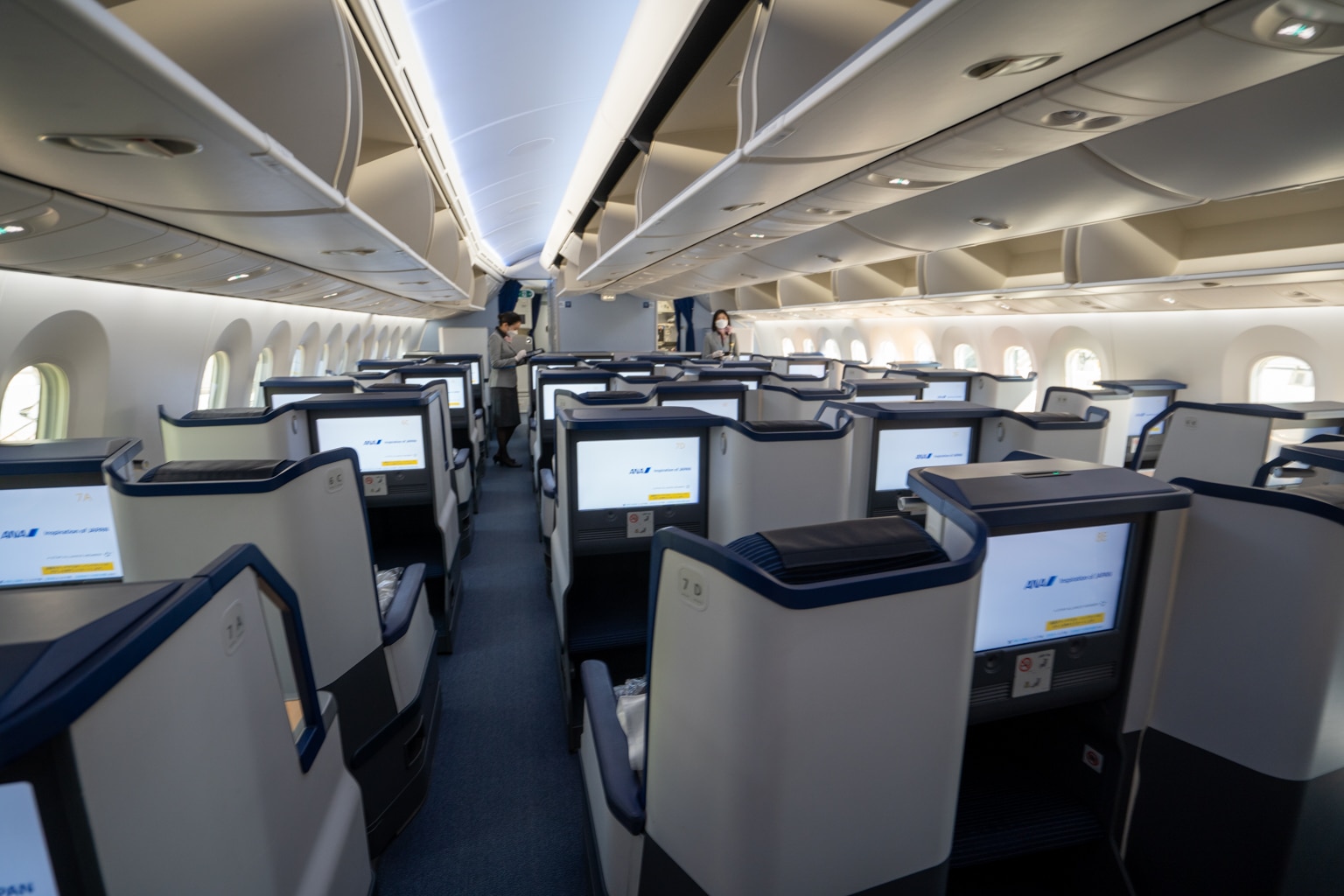
At 100,000 miles round-trip or 50,000 miles one-way, low-season business class between North America and Japan remains the crown jewel of ANA Mileage Club. For context, Aeroplan prices the same routing at 75,000 miles one-way as a fixed-partner award (150,000 round-trip equivalent), meaning ANA's own chart is 33% cheaper.
United MileagePlus uses dynamic pricing that often lands at 140,000-200,000+ miles round-trip. No other major program comes close to ANA's low-season pricing for this route.
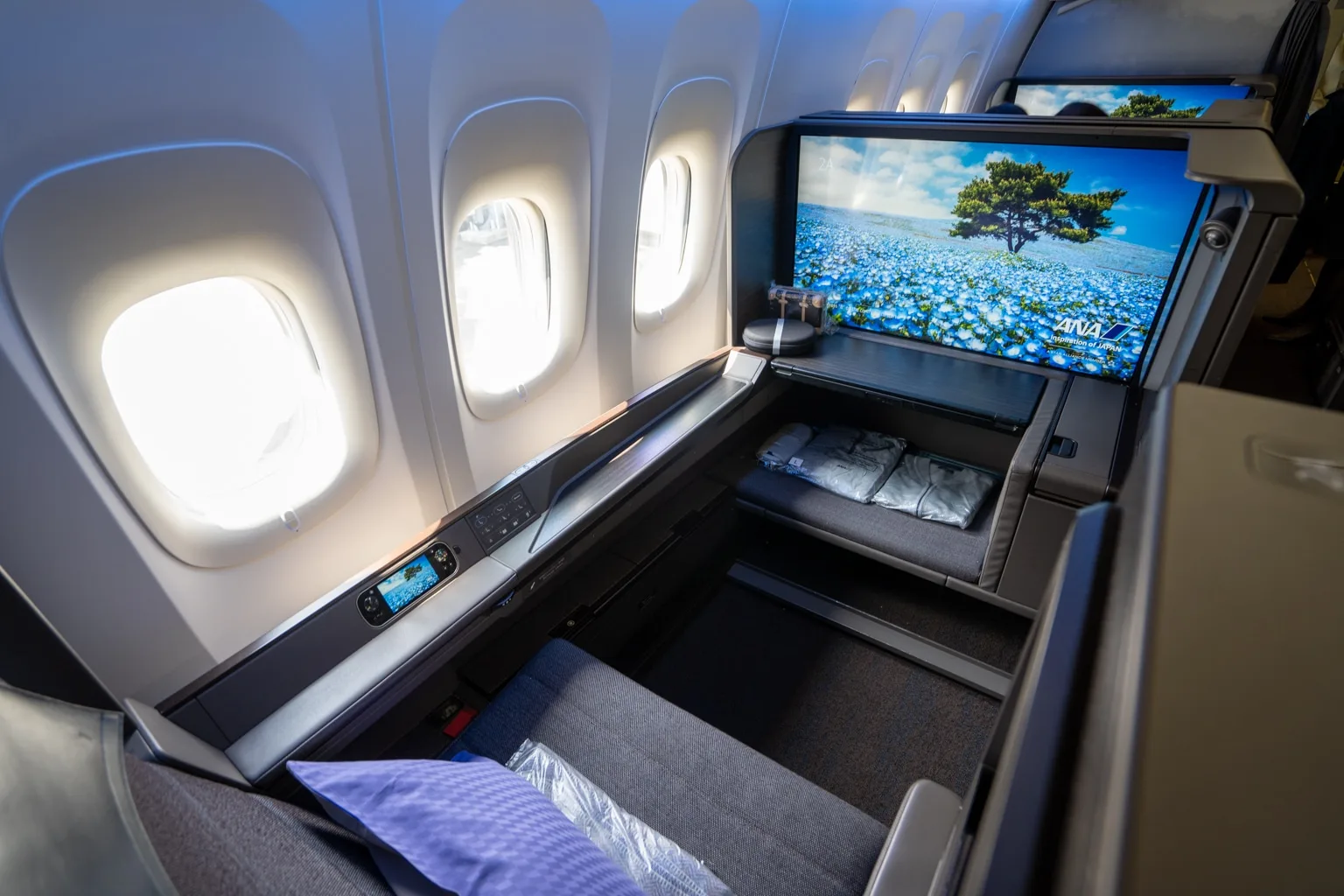
The product you are booking is "The Room," ANA's business class suite with a door, widely considered one of the best business class products in the world. At 50,000 miles per direction, the value proposition is exceptional.
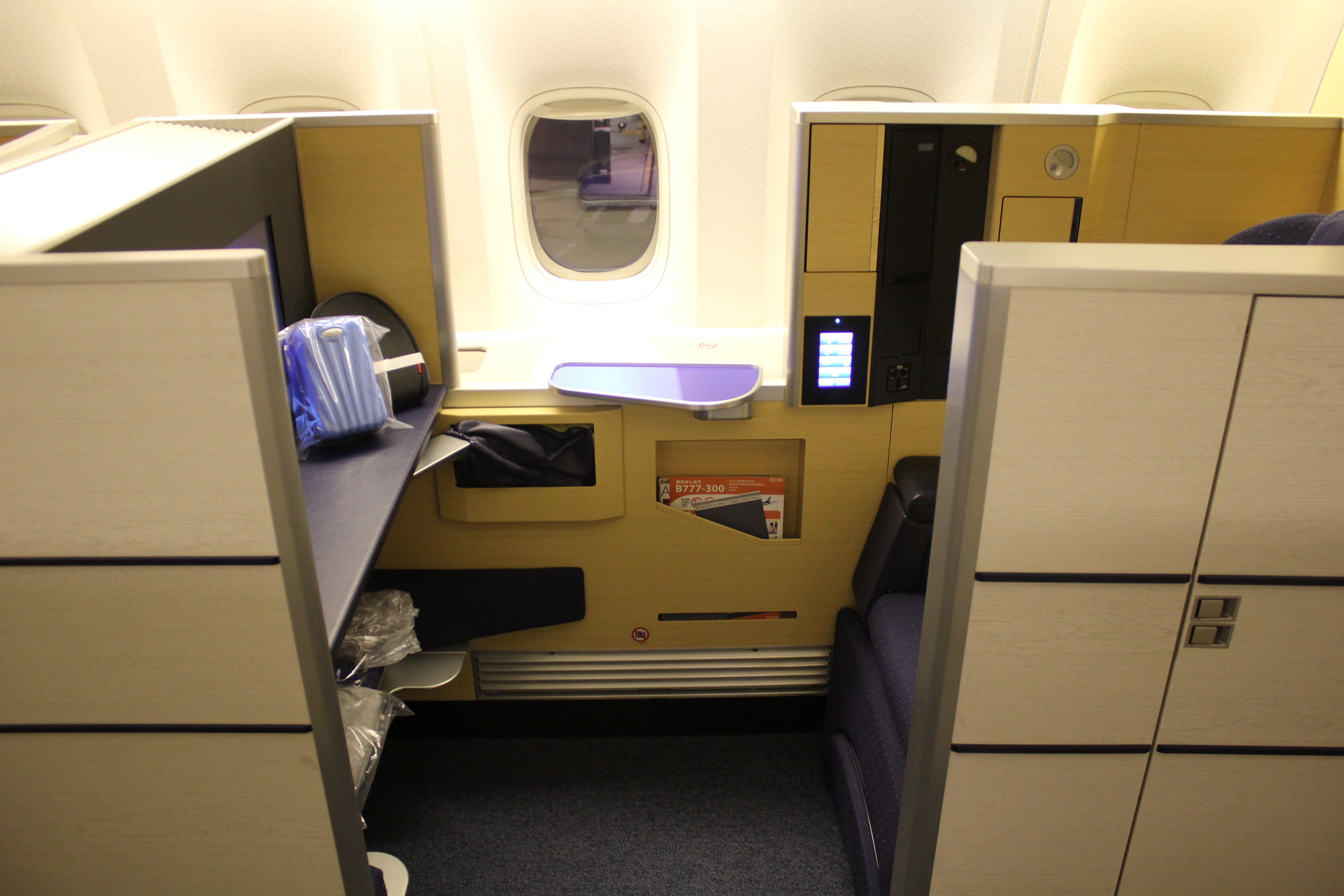
"The Suite," ANA's first class product, can be booked for 150,000 miles round-trip or 75,000 miles one-way in low season. This is among the cheapest first class redemptions to Japan from any program.
Availability is the challenge: ANA typically releases only one first class award seat per flight, so you need to book the moment the 355-day booking window opens. In high season, first class jumps to 300,000 miles round-trip, which is not recommended.
The partner award chart prices North America to Europe business class at 100,000 miles round-trip with no seasonal variation. While this is higher than Aeroplan (120,000 miles round-trip at 60,000 per direction), ANA's surcharge-free policy on most partners and own-member priority access to seats can make it worthwhile on specific carriers.
An important caveat on surcharges: while ANA does not pass through fuel surcharges on most partner airlines, Lufthansa and Swiss are notable exceptions. Lufthansa awards booked through ANA still carry surcharges of $2,000+ USD round-trip. Turkish Airlines and TAP Air Portugal, on the other hand, are surcharge-free through ANA, making them the better partner choices for transatlantic business class.
ANA allows one free stopover on any international round-trip award at a legitimate connection point along the routing, at no additional mileage cost. For example, you could book Vancouver-Tokyo-Bangkok round-trip and spend a week in Tokyo on the outbound, then fly directly Bangkok-Tokyo-Vancouver on the return.
The stopover is free. This effectively gives you two destinations for the price of one and is one of the program's most underappreciated features. Note that stopovers are not available on one-way awards.
In addition to flights on ANA's own metal, ANA Mileage Club allows you to book award flights across the full Star Alliance network and several non-alliance partners. Partner awards use a separate zone-based chart with no seasonal variation, meaning the price is the same regardless of when you travel.

| Route | Economy | Business | First |
|---|---|---|---|
| Japan to North America | 50,000 | 110,000 | 170,000 |
| Japan to Europe | 55,000 | 115,000 | 190,000 |
| Japan to Southeast Asia | 35,000 | 60,000 | 105,000 |
| North America to Europe | 55,000 | 100,000 | 165,000 |
Partner awards remain round-trip only until May 19, 2026, when a new partner award chart takes effect that will introduce one-way partner pricing. The current partner chart was not affected by the June 2025 overhaul.
An important nuance on mixing carriers: Star Alliance partner flights can be freely combined within a single itinerary (for example, Lufthansa transatlantic plus Turkish Airlines intra-Europe on the same ticket). However, non-alliance partners (Etihad, Virgin Atlantic, etc.) cannot be mixed with Star Alliance carriers on the same booking.
ANA's surcharge policy on partner awards is generally favourable but not universal. Most partners are surcharge-free when booked through ANA, but Lufthansa and Swiss are notable exceptions — Lufthansa awards carry surcharges exceeding $2,000 (USD) round-trip even when booked through ANA. Turkish Airlines and most other Star Alliance partners remain surcharge-free through ANA, which is a significant advantage over booking through those carriers' own programs or through Aeroplan.
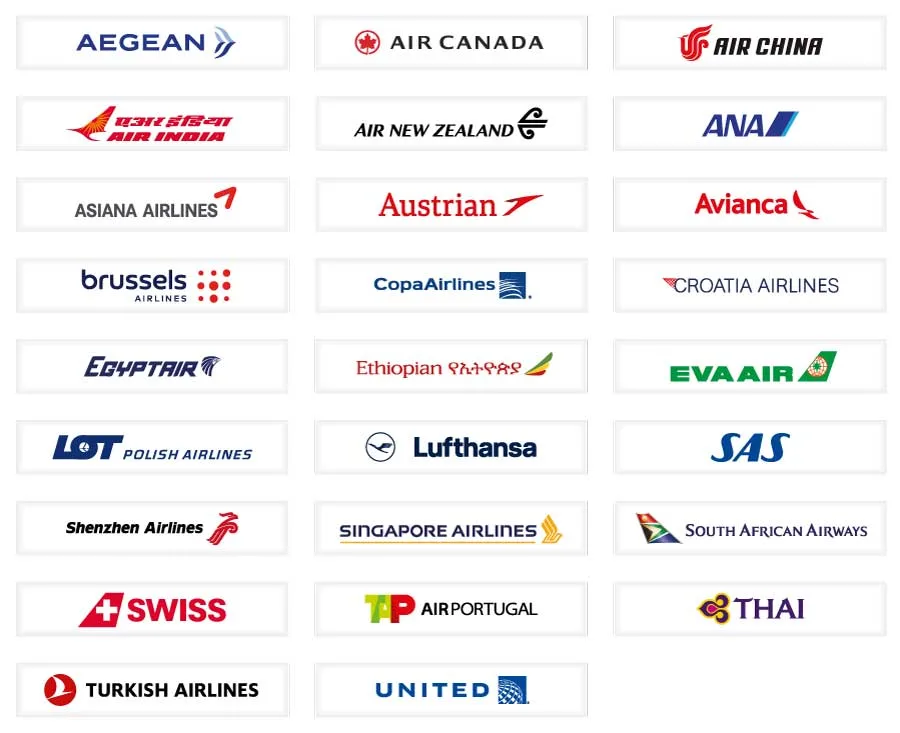
ANA's Star Alliance partners include Aegean Airlines, Air Canada, Air China, Air India, Air New Zealand, Asiana Airlines, Austrian, Avianca, Brussels Airlines, Copa Airlines, Croatia Airlines, EgyptAir, Ethiopian Airlines, EVA Air, LOT Polish Airlines, Lufthansa, Shenzhen Airlines, Singapore Airlines, South African Airways, Swiss, TAP Air Portugal, Thai Airways, Turkish Airlines, and United Airlines. (Note: SAS left Star Alliance in September 2024 and joined SkyTeam, so it is no longer bookable as a Star Alliance partner through ANA.)
Non-alliance partners include Etihad Airways, Eurowings, Philippine Airlines, and Virgin Atlantic. Virgin Atlantic is a particularly noteworthy partner given that VA is a SkyTeam carrier, making this a rare cross-alliance arrangement.
Since June 24, 2025, ANA Mileage Club offers one-way awards on ANA's own metal, priced at exactly half the round-trip cost. This was a long-awaited change. Previously, ANA was one of the few remaining major programs that required round-trip bookings with no one-way option at all on ANA's own metal.
That said, round-trip bookings on ANA's own metal still offer an additional benefit: the free stopover. Since stopovers are not available on one-way awards, a round-trip booking gives you more routing flexibility.
In low and regular season, there's no pricing penalty for booking round-trip versus two one-ways, since one-way is exactly half the round-trip rate.
For partner awards, round-trip is the only option until the new partner chart takes effect on May 19, 2026, at which point one-way partner awards will become available with revised pricing.
ANA opens award availability 355 days before the departure date (for one-way awards) or 355 days before the return flight date (for round-trip awards). This means that on a round-trip booking, if your return is 355 days out, your outbound can actually be even further out than 355 days.
The most strategically important aspect of booking through ANA Mileage Club is own-member priority. ANA releases award seats to its own Mileage Club members before they become visible to partner programs like Aeroplan, United MileagePlus, or Avianca LifeMiles.
This means you can see and book award space through ANA that simply does not exist when searching through other Star Alliance programs. For premium cabin awards, particularly first class, this priority access is often the difference between finding availability and not.
ANA is one of the very few airline programs that offers award waitlisting. If your desired flight shows no award availability, you can place yourself on a waitlist for one flight per one-way segment. Waitlists can clear weeks or even months before the departure date, with a maximum hold period extending to two weeks before departure.
This is a genuinely unique feature. Most major programs simply show "no availability" and leave you to check back manually. ANA's waitlisting system lets you stake a claim and get notified if space opens up, which is particularly valuable for high-demand routes like North America to Japan in premium cabins.
Members residing outside Japan can register 2-8 family members in a Family Account to pool miles for redemptions. Eligible members include spouses and same-sex partners, as well as relatives within two degrees of kinship (parents, children, siblings, grandparents, grandchildren). Registration costs 1,000 miles per person.
When redeeming, miles from all registered family members are automatically combined, with miles deducted in order of earliest expiration date. This is an excellent feature for families where multiple members earn small balances that would not be sufficient individually for a premium cabin redemption but are meaningful when pooled together.

ANA miles expire 36 months after they are earned. This is a hard expiry with no extensions and no activity-based resets.
Unlike programs such as Aeroplan (where any account activity restarts the clock), ANA miles have a fixed lifespan from the moment they post to your account. The exceptions are ANA Diamond Service members and Million Miler members, whose miles do not expire while they maintain their status.
This strict expiry policy means you need to plan your earning and redemption timeline carefully. Transferring a large balance of Amex US MR to ANA and then failing to find award space within 36 months would result in lost miles, so it is generally advisable to transfer only when you have a specific redemption in mind or at least a clear timeline for booking.
The first award cancellation is free — miles are returned to your account with no penalty. A fee of 3,000 JPY (approximately $20 USD) or 3,000 miles per person applies only after a reservation change has been made (i.e., if you change a booking and then cancel it).
Same-day flight changes to a different flight on the same route are permitted, but you cannot change the name, airline, class of service, or route after ticketing.
ANA charges fuel surcharges on its own metal, typically ranging from $200-400 round-trip between North America and Japan depending on current jet fuel prices.
Most partner airline flights booked through ANA are surcharge-free, which is a significant advantage. However, Lufthansa and Swiss are notable exceptions — Lufthansa awards carry surcharges exceeding $2,000 (USD) round-trip even when booked through ANA.
Turkish Airlines, TAP Air Portugal, and most other Star Alliance partners remain surcharge-free through ANA, making them attractive choices where surcharges through their own programs or Aeroplan can add hundreds of dollars.
Awards can only be booked for the member and for family members registered in the Family Account (up to 10 members). Unlike some other programs, ANA does not allow booking awards for unrelated third parties, even if they are ANA Mileage Club members. This restriction makes the Family Account registration particularly important for couples and families.
ANA Mileage Club is arguably the single most compelling reason for Canadian points enthusiasts to establish a US credit card portfolio. The pathway is well-trodden: start with a Canadian Amex card, use Amex Global Transfer to open an Amex US card without a US credit history, earn Amex US MR through spending, and transfer to ANA at 1:1. The payoff is access to award pricing that no Canadian-accessible program can match.
For context, consider a round-trip business class flight from Vancouver to Tokyo in low season. Through ANA Mileage Club, that costs 100,000 miles.
Through Aeroplan, the same flight costs 150,000 points (75,000 each way as a fixed-partner award). ANA is 33% cheaper for an identical product, and you get access to award space before Aeroplan members can even see it.
The trade-off is accessibility. Aeroplan is directly accessible from Canadian Amex MR at 1:1, from American Express Cobalt via Aeroplan conversion, and from a broad range of Canadian credit cards.
ANA requires the additional step of establishing a US credit card. For travellers who already have Amex US cards or are willing to set them up, ANA is the clear winner for Japan.
For those who want simplicity, Aeroplan remains the practical choice with its own advantages: flexible one-way pricing, a wider availability window (since ANA shows its own members space first), and the ability to add a stopover for just 5,000 additional points.
ANA flies nonstop from Vancouver (YVR) to Tokyo Narita (NRT), making it the most direct option for western Canadians. There are no ANA nonstop flights from Toronto or Montreal, so eastern Canadians will need to connect through a US gateway or book Air Canada through ANA's partner award chart.
One additional option worth noting: Marriott Bonvoy transfers. Canadian Amex MR transfers to Marriott Bonvoy at 1:1.2, and Bonvoy transfers to ANA at 3:1 with the 5,000-mile bonus per 60,000 Bonvoy.
This indirect path yields roughly 25,000 ANA miles per 50,000 Canadian MR, which is poor value. However, it can serve as a useful top-up mechanism if you're a few thousand miles short of a redemption and do not want to (or cannot) transfer more from Amex US MR.
ANA Mileage Club has three Premium membership tiers: Bronze, Platinum, and Diamond. Advancement is based on Premium Points, which are distinct from miles and earned exclusively through paid flights on ANA and partner airlines. Premium Points are calculated based on route, fare class, and operating carrier.
The qualification thresholds in a calendar year are 30,000 Premium Points for Bronze (15,000 must be from ANA flights), 50,000 Premium Points for Platinum (25,000 from ANA), and 100,000 Premium Points for Diamond (50,000 from ANA). The same thresholds apply for requalification in subsequent years.
Bronze status grants Star Alliance Silver benefits, while Platinum and Diamond grant Star Alliance Gold. The full benefits package across tiers includes flight bonus miles, lounge access, seat upgrade awards, a premium service desk, priority waitlisting on cash fares and awards, priority check-in, security screening, boarding and baggage handling, additional baggage allowance, and personalized bag tags.
For most Canadian points enthusiasts who are not frequent ANA flyers, elite status is unlikely to be a realistic goal given the requirement that a significant portion of Premium Points come from ANA-operated flights. The program's real value for Canadians lies in its award chart, not its status benefits.
ANA Mileage Club occupies a truly distinctive position among airline loyalty programs. Its low and regular season award pricing for premium cabins to Japan is the cheapest available from any program, full stop. If Japan is on your travel wish list, this is the program to know.
The combination of own-member priority for award releases, a waitlisting system, free stopovers on round-trip awards, and family account pooling makes it a remarkably feature-rich program once you have miles in your account.
The barriers are real: a strict 36-month mileage expiry, a clunky booking website, fuel surcharges on ANA's own metal, and most significantly, the need for Amex US MR as the only efficient transfer source.
The June 2025 high-season devaluation also means the program is no longer competitive during peak travel periods, where Aeroplan or even Virgin Atlantic's fixed pricing for ANA flights may offer better value.
For Canadians who travel to Japan at least occasionally and are willing to establish a US credit card portfolio, ANA Mileage Club is essential. A round-trip in "The Room" business class for 100,000 miles in low season, or "The Suite" first class for 150,000 miles, represents some of the best value in the entire world of points and miles. We consider it a must-know program for any serious points enthusiast.
Plan around low and regular season dates, book early within the 355-day window, and this program will reward you handsomely.

First-year value
$336
Monthly fee: $15.99
• Earn 1,250 points per month upon spending $750 per month for 12 months
Earning rates
Key perks

Monthly fee: $15.99
• Earn 1,250 points per month upon spending $750 per month for 12 months
Earning rates
Key perks