
Air Canada Expands Business Class Basic and Premium Economy Basic to North America

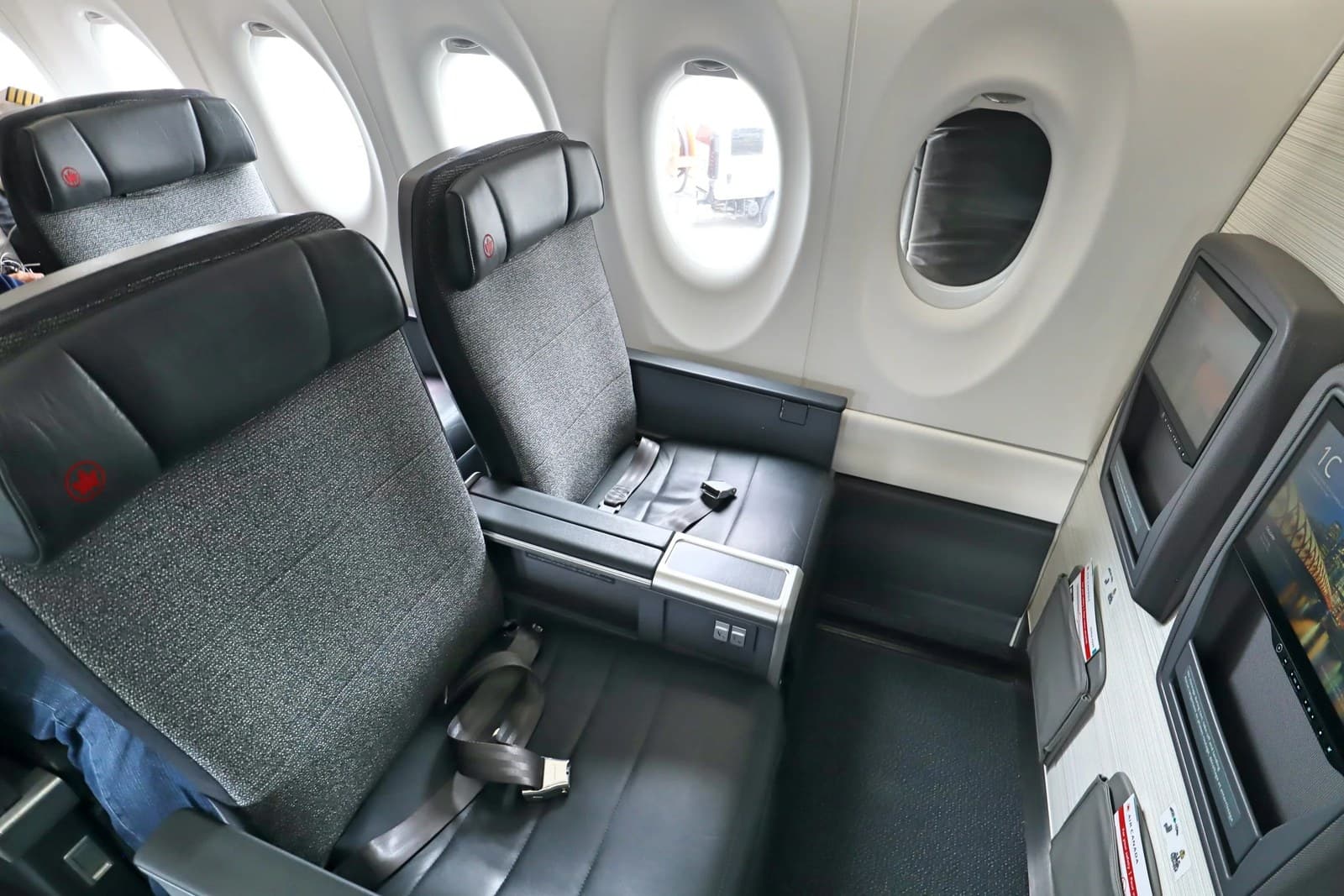
On November 17, 2026, Air Canada added Premium Economy Basic and Business Class Basic to its North American routes, covering flights within Canada and between Canada and the United States. The two fare brands first launched in July on a set of international markets, and North America now joins that list.
Both fares sit below Standard at the bottom of each premium cabin’s fare ladder. They keep the same seat, onboard meal, and priority services, while leaving out some of the extras that come with a Standard fare.
These are cash fares, so nothing changes for Aeroplan flight rewards.
What You Get and What You Give Up
The table below shows what each Basic fare includes on flights within Canada and between Canada and the United States.
| Attribute | Premium Economy Basic | Business Class Basic |
|---|---|---|
| Refunds | Not refundable | Not refundable |
| Changes | Permitted, for a fee | Permitted, for a fee |
| Advance seat selection | For a fee | For a fee |
| Checked bags | 1 complimentary | 1 complimentary |
| Carry-on bag | Permitted | Permitted |
| Lounge access | Not included | Maple Leaf Lounge and Air Canada Café (not the Signature Suite) |
| Priority boarding | Included | Included |
| Priority baggage | Included | Included |
| Onboard meal | Included | Included |
| Aeroplan earning | Aeroplan points and SQC | Aeroplan points and SQC |
| eUpgrades | Not eligible | Not eligible |
A Basic fare gives up the option to cancel, free advance seat selection, the second checked bag, and eUpgrade eligibility compared with Standard in the same cabin. Changes are still permitted for a fee, so a Basic booking isn’t locked in if your dates shift.
The core of the trip stays the same. The seat, the onboard meal, priority boarding, and priority baggage match what a Standard fare gets you in Air Canada premium economy and Air Canada business class.

Air Canada says the fares let travellers pay only for the benefits they value. Someone who doesn’t need full refundability, seat selection, or a second checked bag can leave those extras out. Anyone who wants them can still book Standard.
How Much You Save with a Basic Fare
To see how the new fares price, I looked up a non-stop flight from Toronto to Vancouver. Premium Economy Basic came to $1,243 one-way with taxes and fees included, compared with $1,299 for Standard and $1,525 for Latitude.
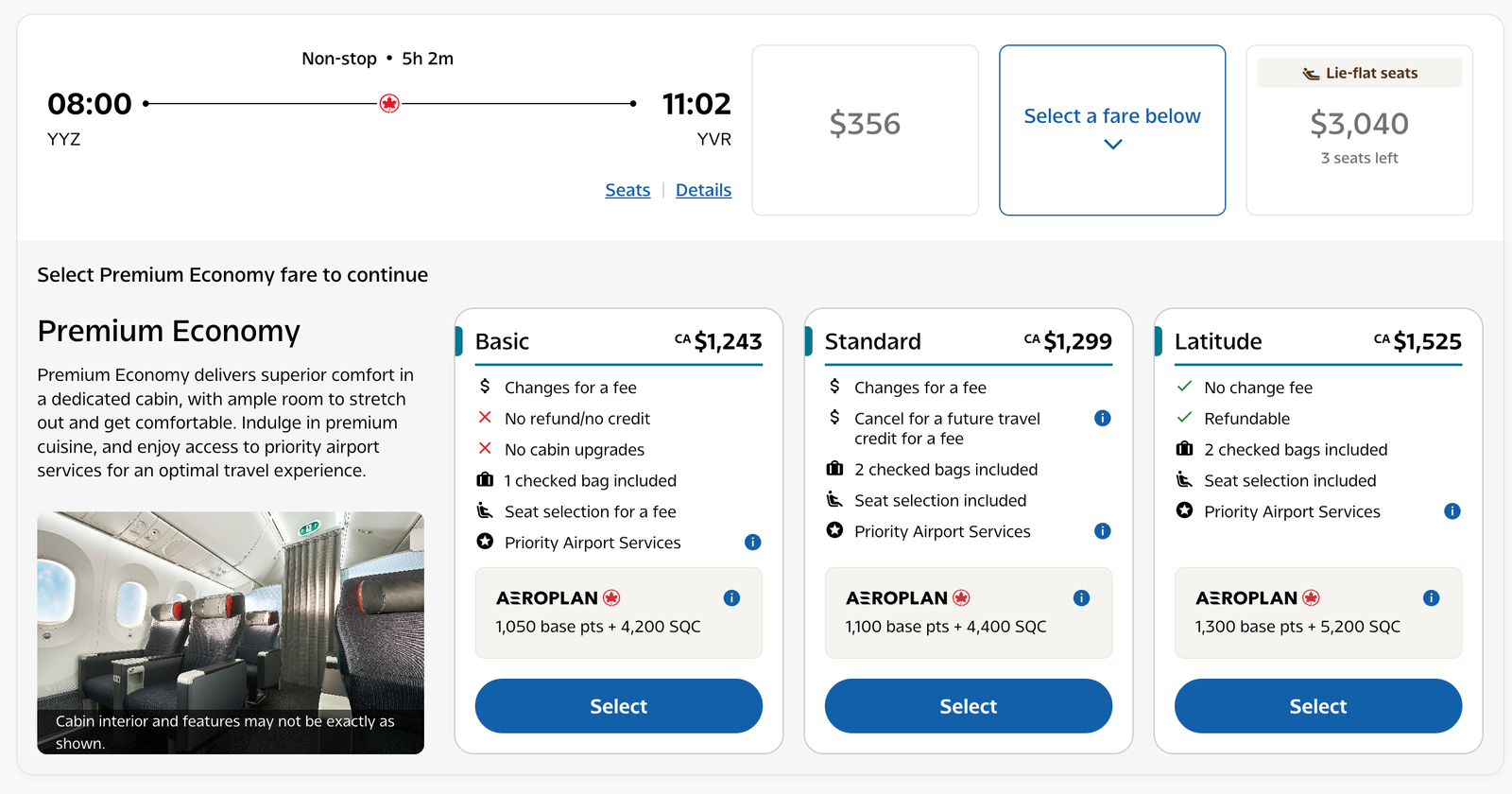
That’s a $56 gap between Basic and Standard, or a little over 4%. For that $56, Standard adds a second checked bag, advance seat selection, and eUpgrade eligibility. It also lets you cancel for a future travel credit for a fee, where Basic offers no refund and no credit.
At a gap that narrow, Standard looks like the better value for anyone who’d otherwise pay to pick a seat or check a second bag. Basic makes more sense if you travel light, your plans are firm, and you don’t need to pick your seat in advance.
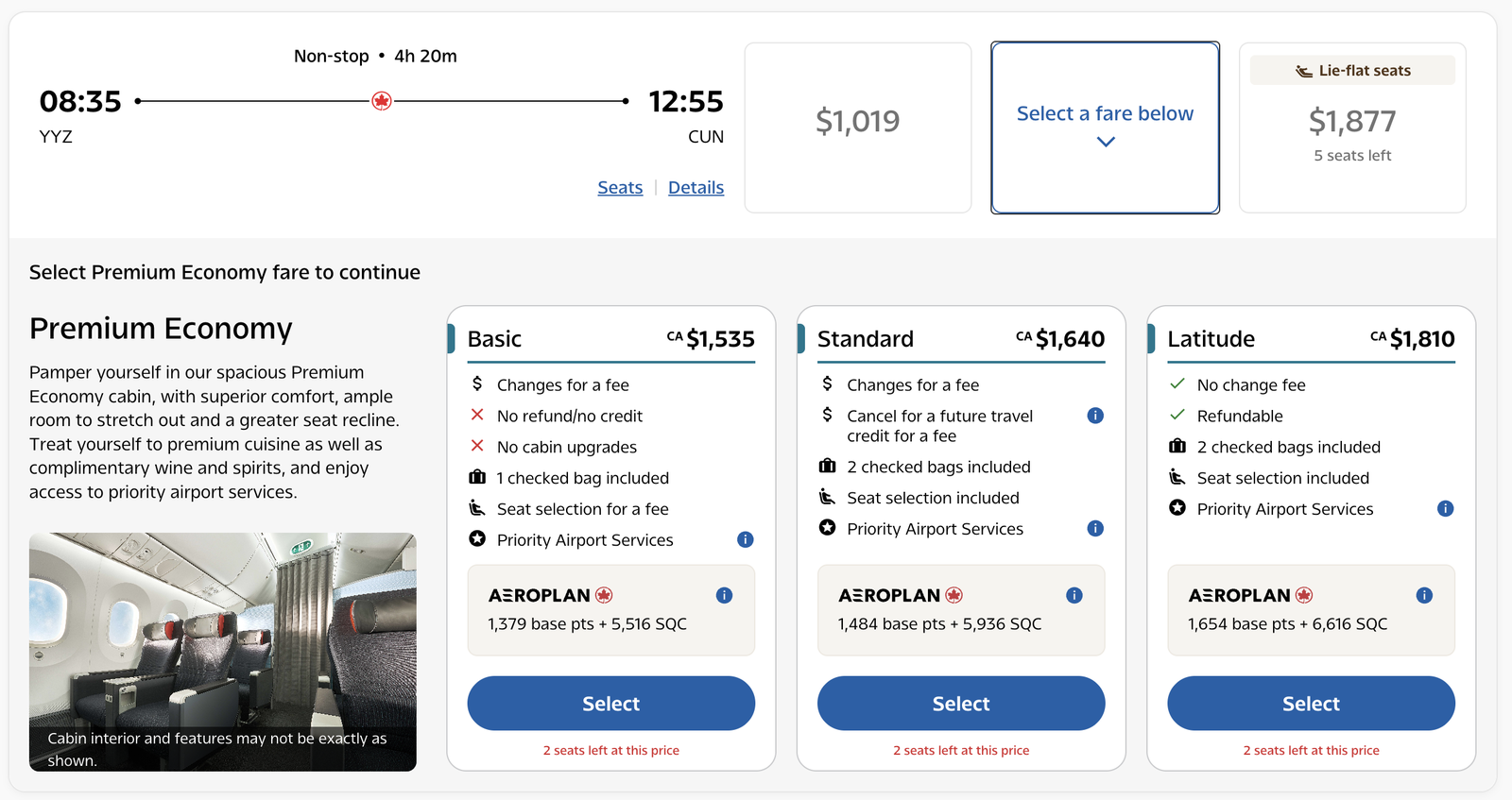
The gap was wider on two routes where the Basic fares have been sold since July. On a non-stop flight from Toronto to Cancún, Premium Economy Basic was $1,535 and Standard was $1,640. That’s a difference of $105, or a little over 6%.
On a non-stop flight from Toronto to London in January, the two fares were $2,235 and $2,395. The $160 difference works out to close to 7%.
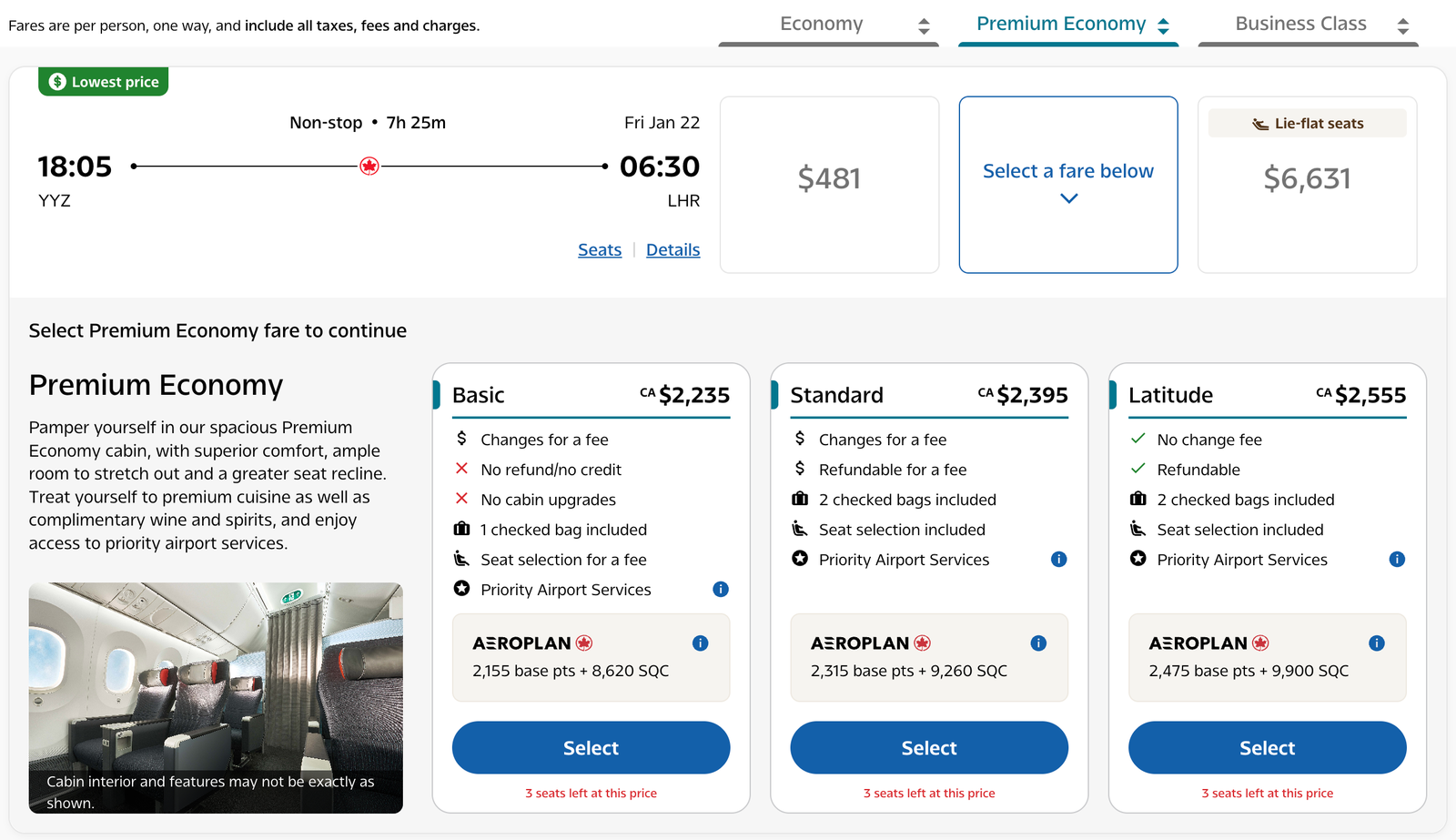
Standard on the London flight is refundable for a fee, which goes a step beyond the future travel credit on the other two flights. Three searches don’t make a rule, and the gap will vary by route and date. It’s worth comparing both fares side by side before you book.
I didn’t come across a Business Class Basic fare on the flights I searched, so I don’t have a price example for that cabin yet.
Full SQC on the Lowest Premium Fare
Both Basic fares earn 4 Status Qualifying Credits (SQC) per dollar on the base fare and carrier surcharges. That’s the same rate as every other premium economy and business class fare. Taxes, fees, and third-party charges don’t count.
Economy works differently. Economy Basic earns no SQC at all, Economy Standard earns 2 SQC per dollar, and Economy Flex and higher earn 4 SQC per dollar.
On the Toronto to Vancouver flight above, the $1,243 Premium Economy Basic fare earns 4,200 SQC and 1,050 base Aeroplan points. That’s about a sixth of the 25,000 SQC needed for Aeroplan 25K status from a single one-way flight.
Standard earns 4,400 SQC on the same flight. The extra 200 SQC comes only from its higher base fare, since both fares earn at the same rate.
Aeroplan points are earned on the same base. Members earn 1 point per dollar, and Elite Status members earn between 2x and 6x depending on their status at the time of travel.
This carries more weight now that the fares are on North American routes, since those are the flights where many Aeroplan members earn most of their SQC. For anyone working toward status, a Basic fare in a premium cabin earns at the full rate while sitting below Standard on price.
eUpgrades Are Out, but Status and Card Benefits Stay
You can’t use eUpgrades on either Basic fare. On Premium Economy Basic, that rules out moving up to business class with an eUpgrade. Priority Rewards vouchers can’t be applied to Basic fares either.
If an upgrade is part of your plan, Standard is the lowest premium economy fare that keeps eUpgrade eligibility. Our guide to the eUpgrade waitlist ranking explains how Air Canada orders upgrade requests on eligible fares.
Other Aeroplan Elite Status benefits still apply on a Basic fare. The Elite points multiplier, priority services, status-based lounge access, and complimentary baggage all carry over. For Elite members, that complimentary baggage can soften the loss of the second checked bag.
Benefits from eligible Aeroplan co-branded credit cards also still apply. That brings a Basic fare closer to Standard for travellers who already hold status or one of those cards.
Business Class Basic includes Maple Leaf Lounge and Air Canada Café access. It doesn’t include the Signature Suite, which serves eligible international business class passengers, so the exclusion changes little on a North American itinerary.

Premium Economy Basic has no lounge access through the fare. Travellers with lounge access through Elite Status or an eligible Aeroplan credit card keep it, so this part of the fare won’t change anything for them.
Where the Basic Fares Are Now Sold
North America joins the markets where Air Canada first introduced the Basic fares on July 28, 2026. Those markets are the Caribbean, Latin America, Mexico, and South America.
Transatlantic joint venture routes operated alongside United Airlines and Lufthansa Group are also included, with the exception of Iran, Israel, and the United Arab Emirates. Nothing changes for any of those markets, which continue to sell both fares.
The transpacific network isn’t on the list of markets.
Standard and Latitude, the premium fares Air Canada renamed from Lowest and Flexible in July, are unchanged.
Economy Basic has been part of Air Canada’s North American fare ladder for years, so this structure will be familiar to anyone who flies domestically or to the United States. Premium economy and business class now follow the same pattern, with Basic, Standard, and Latitude from the bottom up. Our guide on how to choose the right Air Canada fare walks through each fare brand cabin by cabin.
Conclusion
Business Class Basic is a good fit for travellers with fixed plans who carry one checked bag and don’t need to pick a seat in advance. On these routes, it keeps Maple Leaf Lounge access, priority services, and full SQC. If my plans were firm, it’s the Basic fare I’d be most comfortable booking.
Premium Economy Basic suits the same traveller, particularly one who already has lounge access through Elite Status or an eligible Aeroplan credit card. Standard remains the better choice if you might need to cancel, want to choose a seat at no extra cost, or are hoping for an eUpgrade. On the Toronto to Vancouver flight I priced, it was only $56 more.
When these fares launched in July, I wrote that an expansion to more markets wouldn’t be a surprise. They’ve now reached the routes where many Aeroplan members do most of their flying.
On North American routes, Basic separates the premium seat from the extras around it. The cabin decides the seat, and the fare decides how much comes with it.





Member Discussion