
Is FoundersCard Worth It in 2026? I Signed Up to Find Out


I ordered dinner on SkipTheDishes last month and, after checking out, got an offer that had nothing to do with what I was eating. It was a complimentary 12-month FoundersCard membership, with US$0 due that day, a preferred renewal rate of US$395 per year, and the option to cancel online at any time.
I knew the name, mostly from older reviews that made FoundersCard sound like a shortcut to an impressive collection of travel statuses. I also knew many of those reviews were dated, so I signed up out of curiosity and told myself it would at least make for a useful experiment.
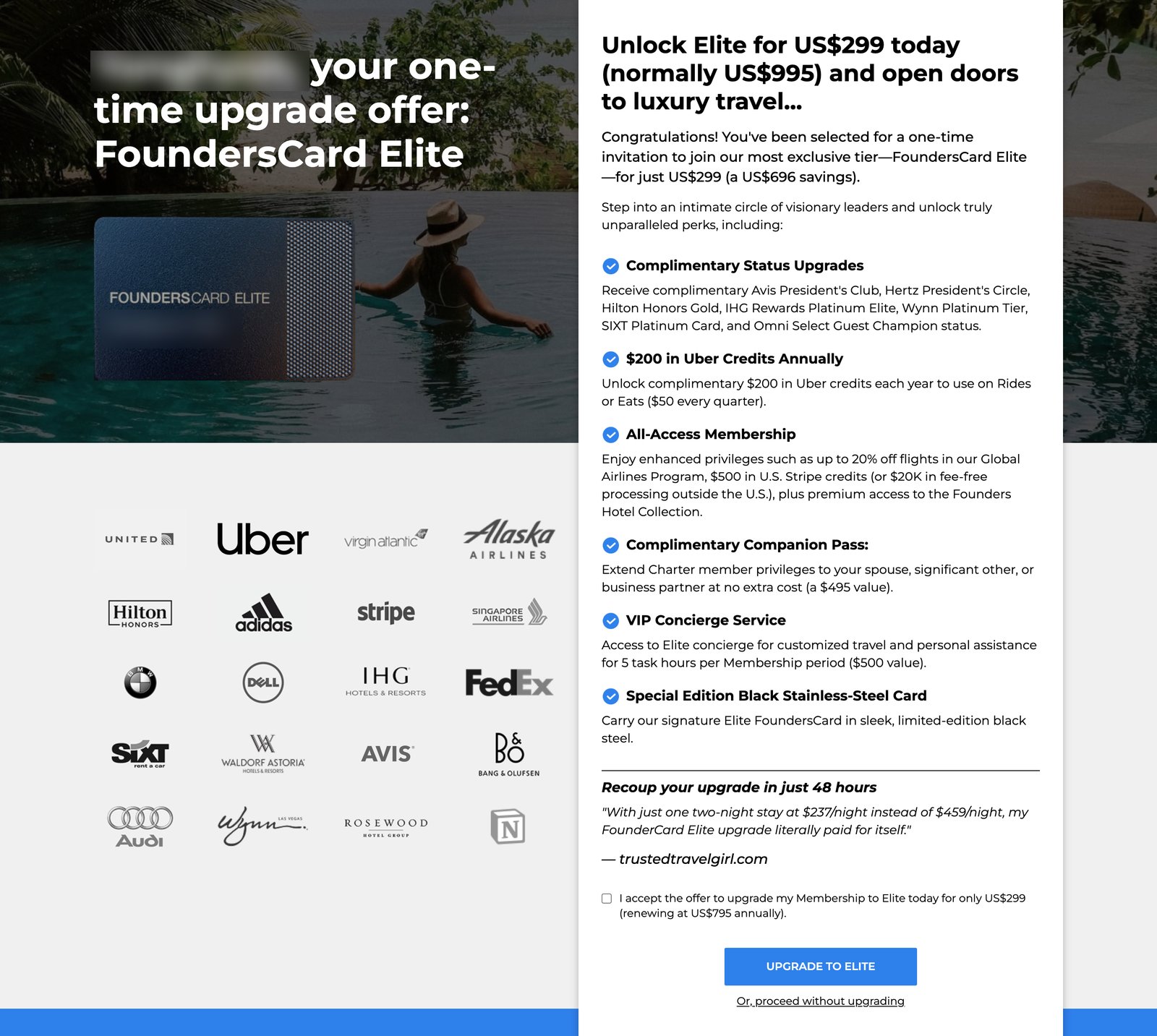
The application was “fast-tracked and approved.” Once inside, however, the complimentary Charter tier came with barely any of the headline benefits. FoundersCard then showed me a one-time offer to upgrade to Elite for US$299 for the first year, positioned against a normal price of US$995, with renewal at US$795 per year.
What really got my attention was a new Elite benefit for 2026, a US$200 annual Uber credit. Since I already use Uber and Uber Eats, that brought my effective first-year cost down to roughly US$99. So I upgraded, worked through the benefits, and started testing which ones were actually useful from a Canadian perspective.
What Is FoundersCard?
FoundersCard is a paid membership program aimed at entrepreneurs and business owners. Despite the name and the black metal card it sends Elite members, it isn't a credit card or a charge card, and you can't use it to pay for anything.
Instead, the membership bundles negotiated discounts, loyalty statuses, and business perks. FoundersCard claims more than 500 benefits and a community of over 300,000 members.
Those numbers make the program sound broader than it feels in practice. Most of the 500-plus benefits are small retail discounts that I wouldn't change my habits to use. A much smaller group can cover the membership cost, and those are the benefits worth focusing on.
The program began with a strong business-traveller pitch, but the roster has changed substantially over the years. That matters because a FoundersCard review from four years ago may describe a much better travel perk than the one you'd receive today.
What It Really Costs
The official pricing is US$595 per year plus a US$95 initiation fee for the standard tier, or US$995 per year plus the same initiation fee for Elite. My honest take is that practically nobody should pay either rack rate.
Those prices mostly function as anchors. Partner and referral funnels routinely lead to much cheaper entry points, and the gap is large enough that it should change how you evaluate the entire program.
- A partner trial can include a free first year, followed by a US$395 annual renewal
- The Charter tier can cost US$99 for the first year, followed by US$295 per year
- A one-time Elite upgrade can cost US$299 for the first year, followed by US$795 per year
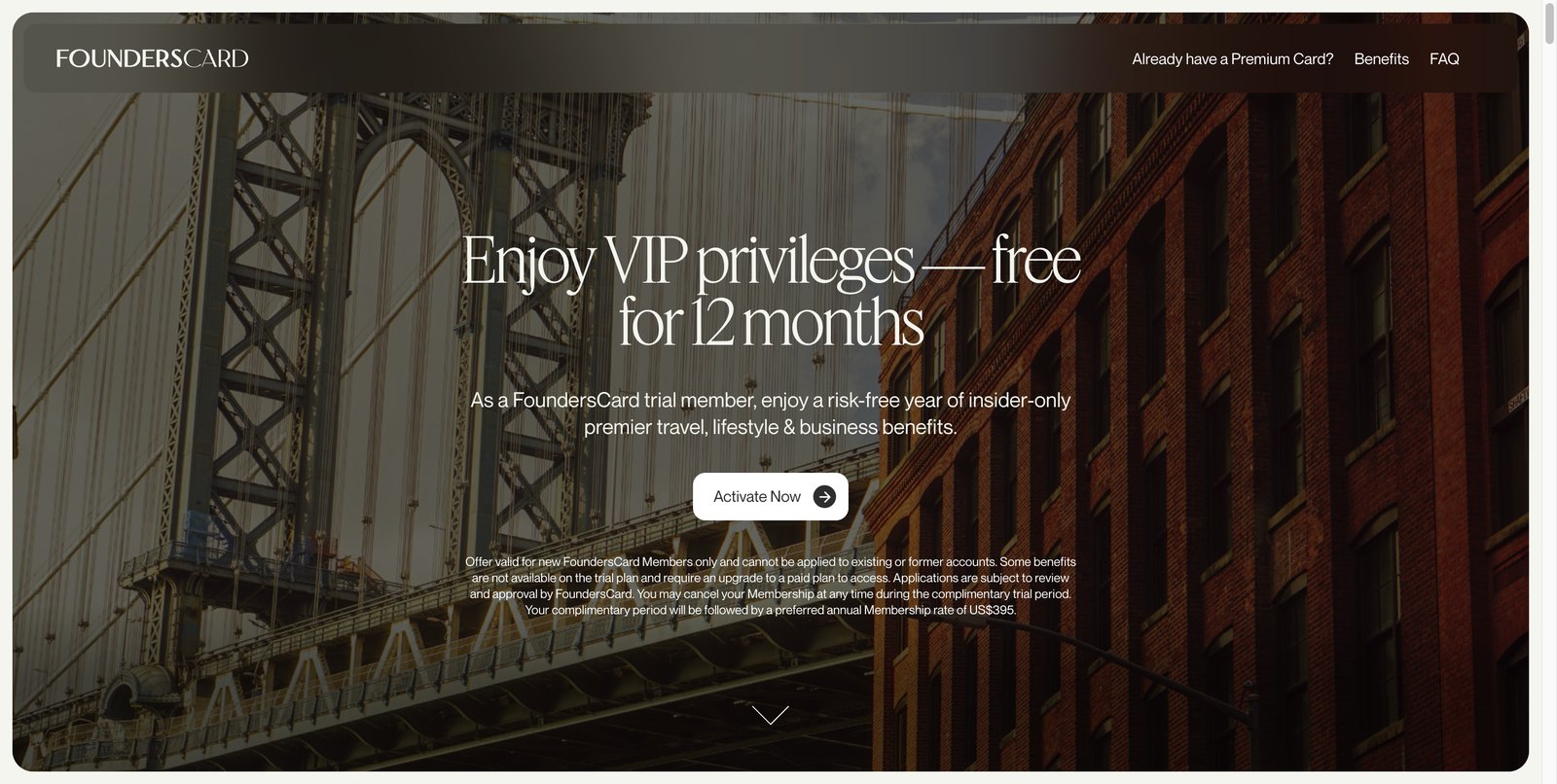
My complimentary offer was for the Charter tier, and on its own it barely moved the needle. Even so, if a free Charter offer lands in front of you, take it. Joining is what put the one-time US$299 Elite upgrade in front of me, and Elite is where the membership starts to mean something.
The first year is the easy part. The renewal price attached to your path is where you have to decide whether the benefits saved real money or merely gave you a long list of logos to scroll through.
Hotel Status Benefits
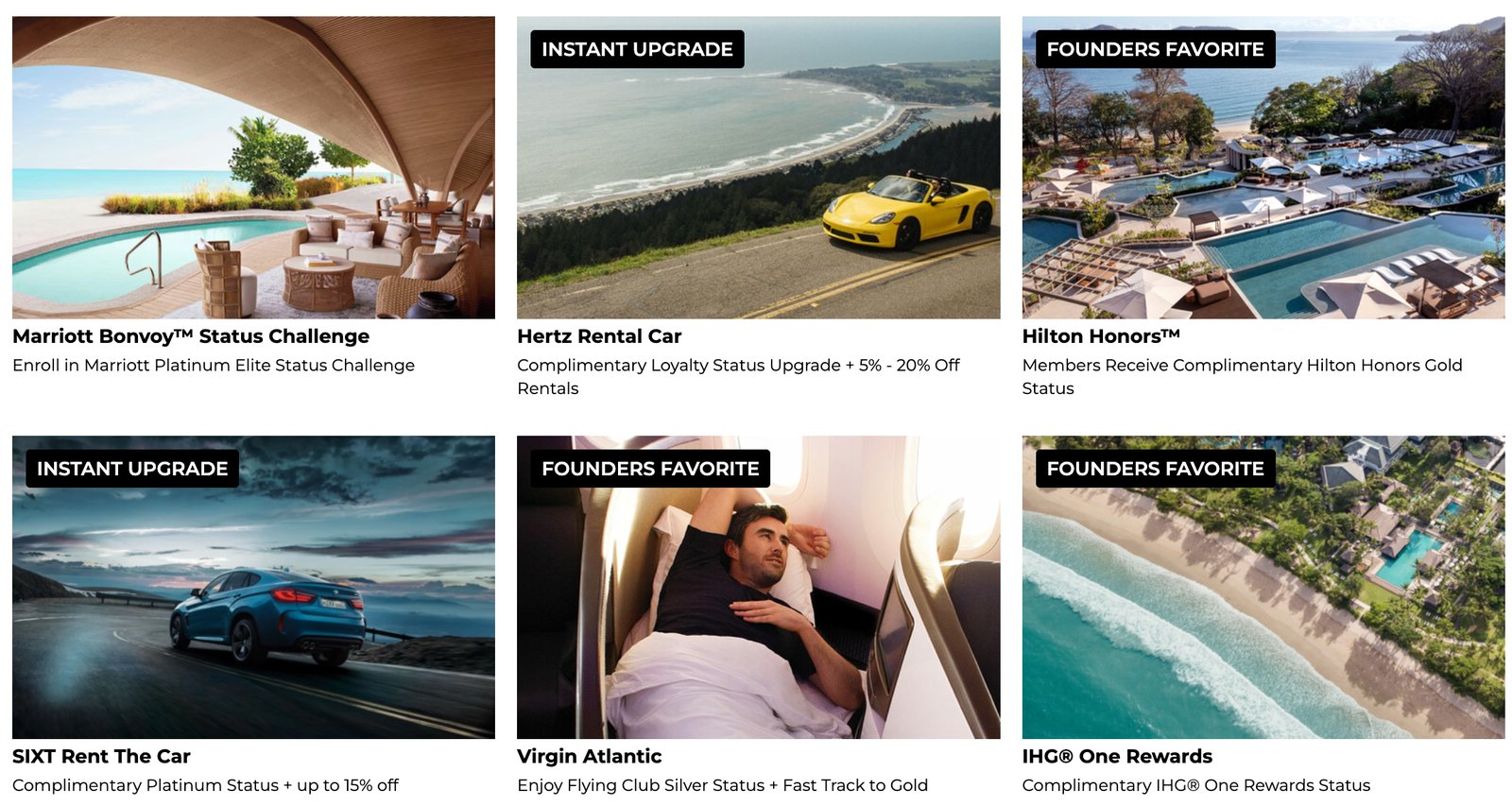
Hotels are still one of FoundersCard's strongest categories. As of August 2026, my Elite account includes several automatic statuses, one useful challenge, and access to the Founders Hotel Collection with negotiated rates at luxury properties.
- IHG One Rewards Platinum Elite, requested through a form with up to two weeks allowed for processing, plus a separate 20% discount on Flexible Rates. Charter members receive Gold instead
- Hilton Honors Gold for all FoundersCard members
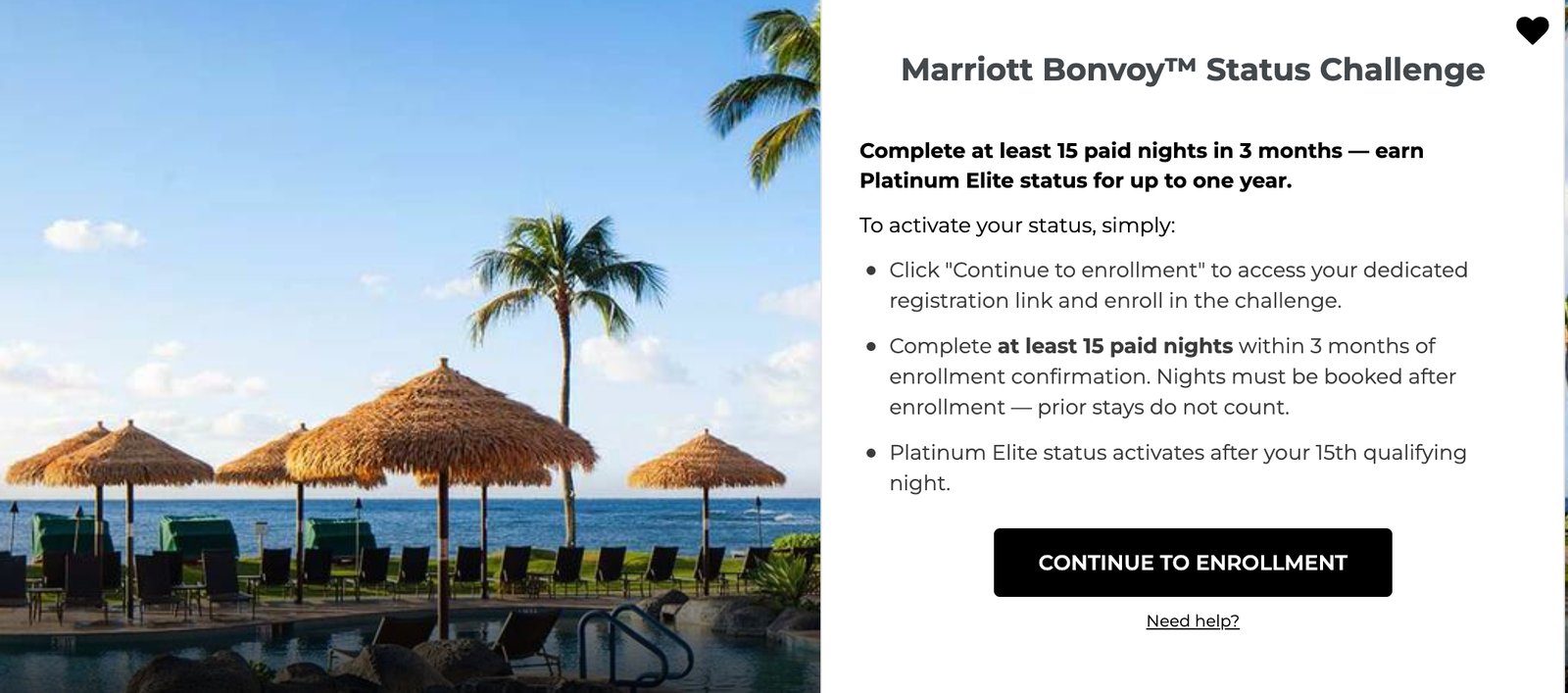
- Marriott Bonvoy Platinum Elite through a paid-night status challenge
- ALL Accor Gold for one year at the Elite tier, extendable through December 2027 after eight eligible Accor nights
- Omni Select Guest Champion, a Sonesta Travel Pass Gold or Platinum challenge, and Wynn Rewards Platinum
This is a useful spread, although not every status carries the same weight. Hilton Gold is available even without Elite, while IHG Platinum is the higher Elite-specific outcome. The Marriott option asks me to complete paid nights, but it could be more valuable than an automatic status because it fits a specific long-term goal.
The Marriott challenge may be the most strategically useful hotel benefit for me. Marriott will typically grant a status challenge only once ever per member when requested by phone, so FoundersCard effectively creates a second entry point.
In my case, I earned Platinum Elite last year, which carries my status through the end of February 2027. When I drop to Gold in March, I plan to start the challenge and requalify for Platinum with just 15 nights. That banks another Platinum year toward lifetime Platinum status, where I'm short on years rather than nights.
The Accor benefit is less distinctive for some Canadians. American Express Platinum Card cardholders in Canada are set to receive Accor Gold later this year through the new partnership between American Express and Accor, so this particular status is about to become easier to obtain.
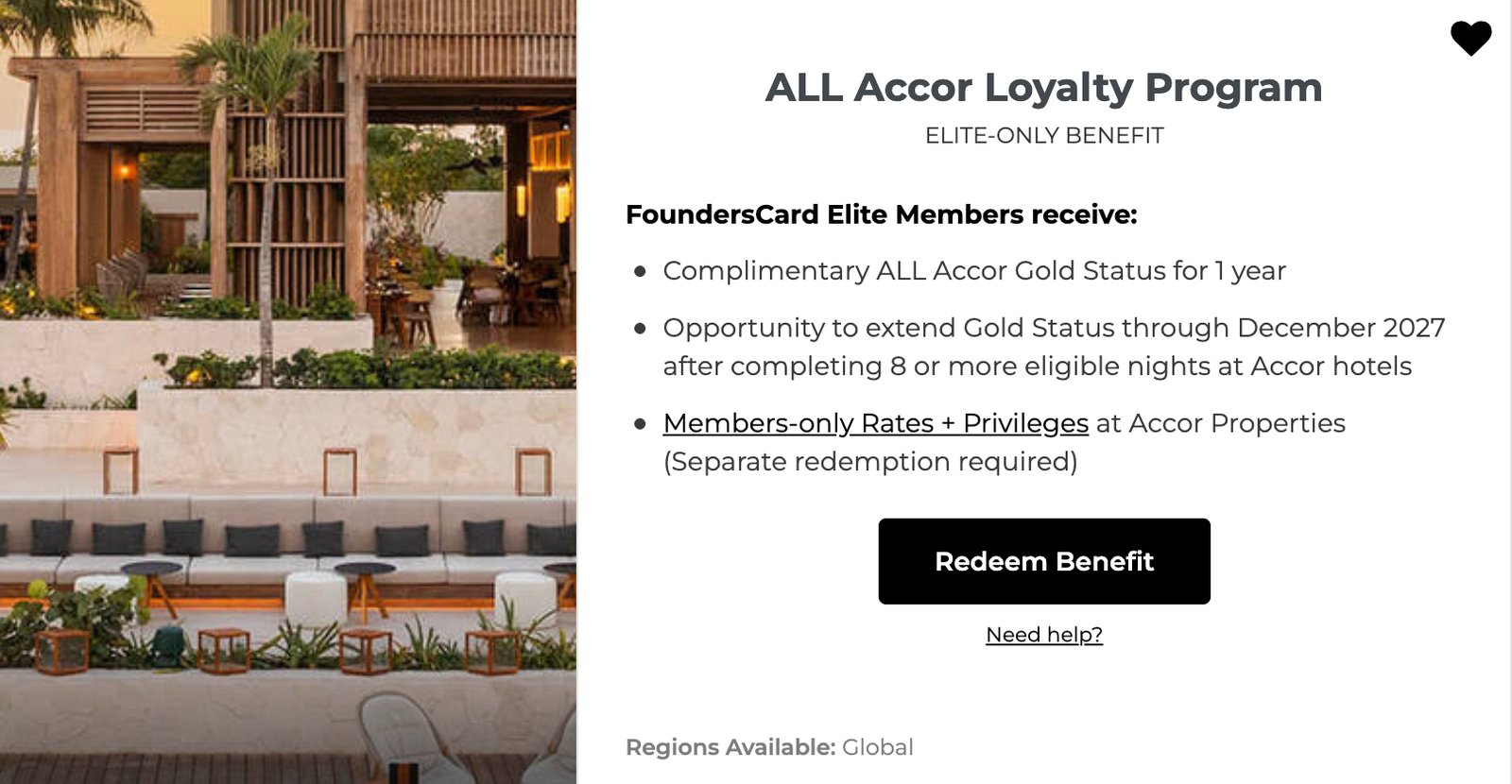
One important historical note is that FoundersCard no longer offers Caesars Diamond. That status once came with a complimentary four-night stay at Atlantis Paradise Island in the Bahamas and was arguably the single best reason to join. The Caesars partnership ended on February 1, 2025, and Wynn Rewards Platinum is now on the roster instead.
Airline Benefits
The airline category looks substantial at first glance, but it requires more restraint. The actual statuses are Virgin Atlantic Flying Club Silver with a fast track to Gold, the newly added United MileagePlus Premier Silver, and Southwest Airlines A-List.
All three sit at the entry-to-mid tier of their respective programs, and all three are more useful to a U.S.-based flyer than a Canadian one. Cathay Pacific, British Airways, and Emirates benefits that appeared on the roster in earlier years are no longer available.
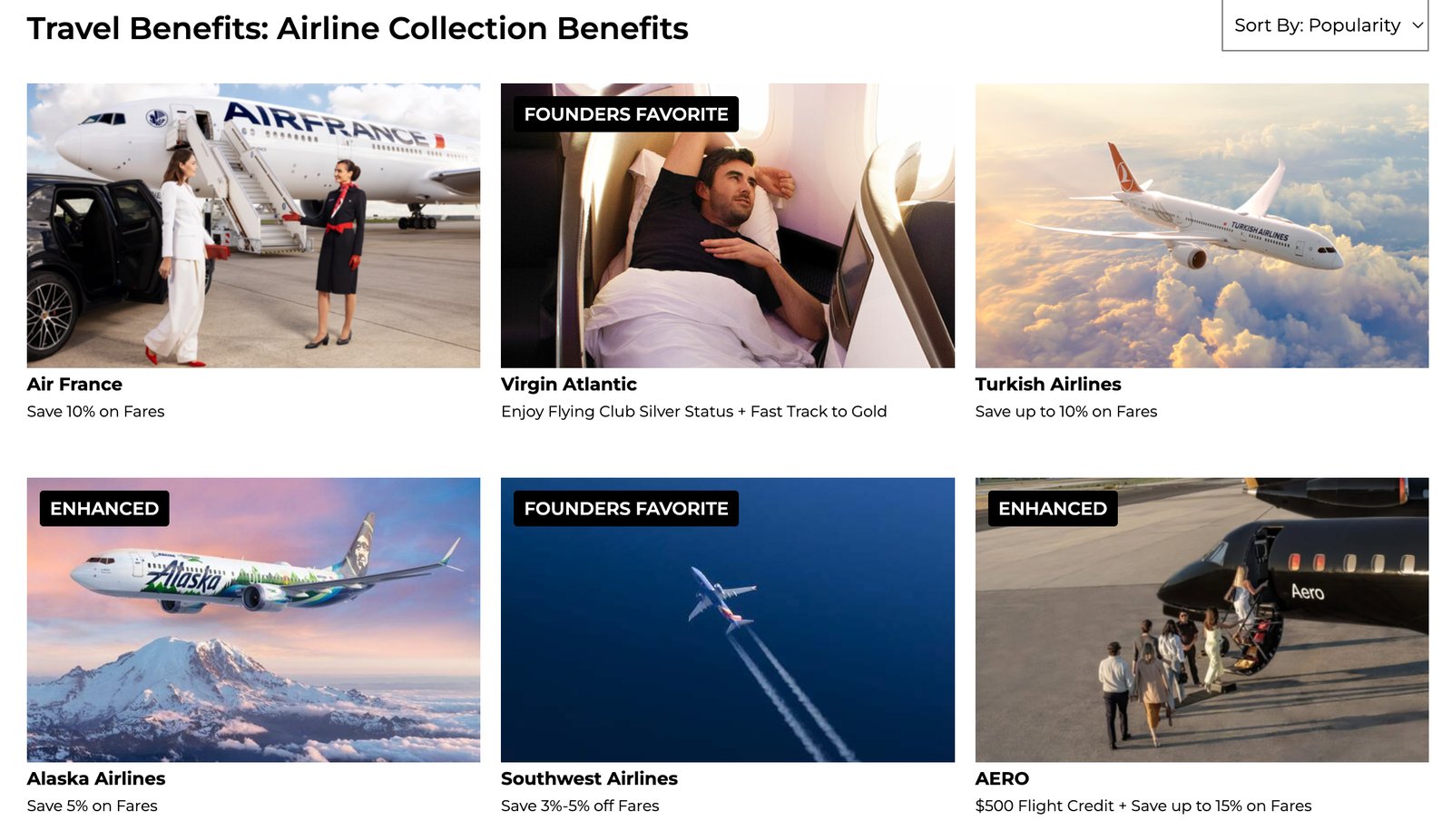
There are also cash-fare discounts across a wider group of airlines. A few of the more notable offers include the following.
- 10% off with Air France and KLM
- Up to 10% off with Turkish Airlines and Qatar Airways
- Up to 15% off with Qantas and Singapore Airlines
- 5–12% off with Air New Zealand
- 2–20% off with United
- 3–5% off with Southwest
The discount list is longer than the status list, with additional offers from Alaska, Hawaiian, and Etihad at 5% each. But the distinction matters. These are most relevant to someone buying cash tickets with the listed airlines, not someone who primarily books award travel from Canada.
These can be useful if you regularly buy eligible cash fares, but they won't transform an Aeroplan or Avios strategy. American Airlines AAdvantage Business enrollment also offers 2–10% off fares, although it's marked as limited availability and enrollment ends August 31.
FoundersCard includes no complimentary airport lounge access. A few lounge offers exist as small discounts, but if you expected a paid travel membership to come with Priority Pass or a comparable lounge program, it doesn't.
Car Rental Benefits
Car rentals are the standout category for me. Elite membership includes Hertz President's Circle, the company's top published tier, while trial and Charter members receive Five Star.
After I linked my accounts, Hertz confirmed President's Circle by email within days. The status earns 1.5 Hertz points per dollar and includes guaranteed one-class upgrades up to a maximum of full-size, a dedicated support line, and a free additional driver for a spouse or domestic partner in the U.S. FoundersCard also provides 5–20% off pay-later rates.

Top-tier Hertz status is especially useful as a starting point for status matching with car rentals. That can extend the value beyond one company when another program will recognize the tier.
Status Matching with Car Rentals
Read moreElite members also receive Avis President's Club, SIXT Platinum, up to 35% off with Budget, and a US$500 Go Rentals credit. For someone who rents frequently, this category can do more work than the airline benefits ever will.
That's why I value the rental benefits differently from a percentage-off coupon. A discount helps on one booking, while a top status can improve repeated rentals and provide the starting point for matches elsewhere. It gives me a reason to keep the membership in mind every time I rent.
The US$200 Uber Credit
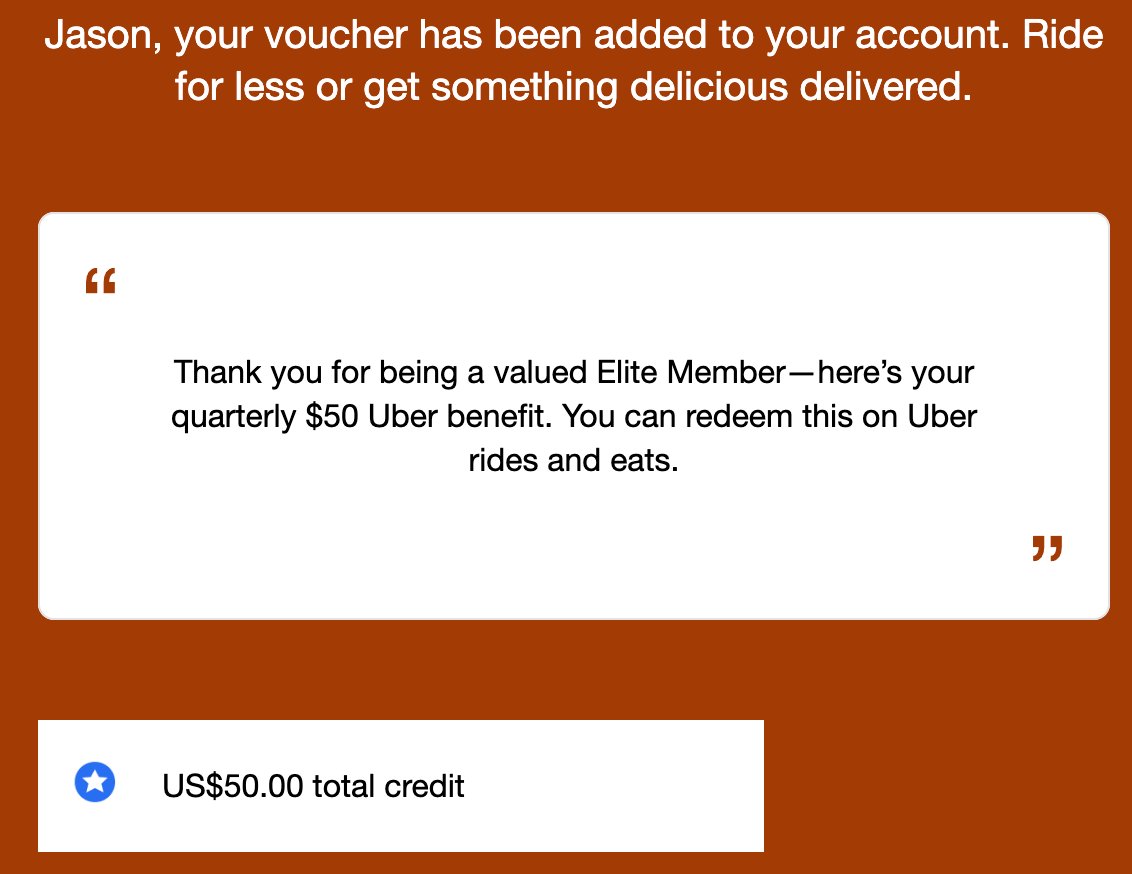
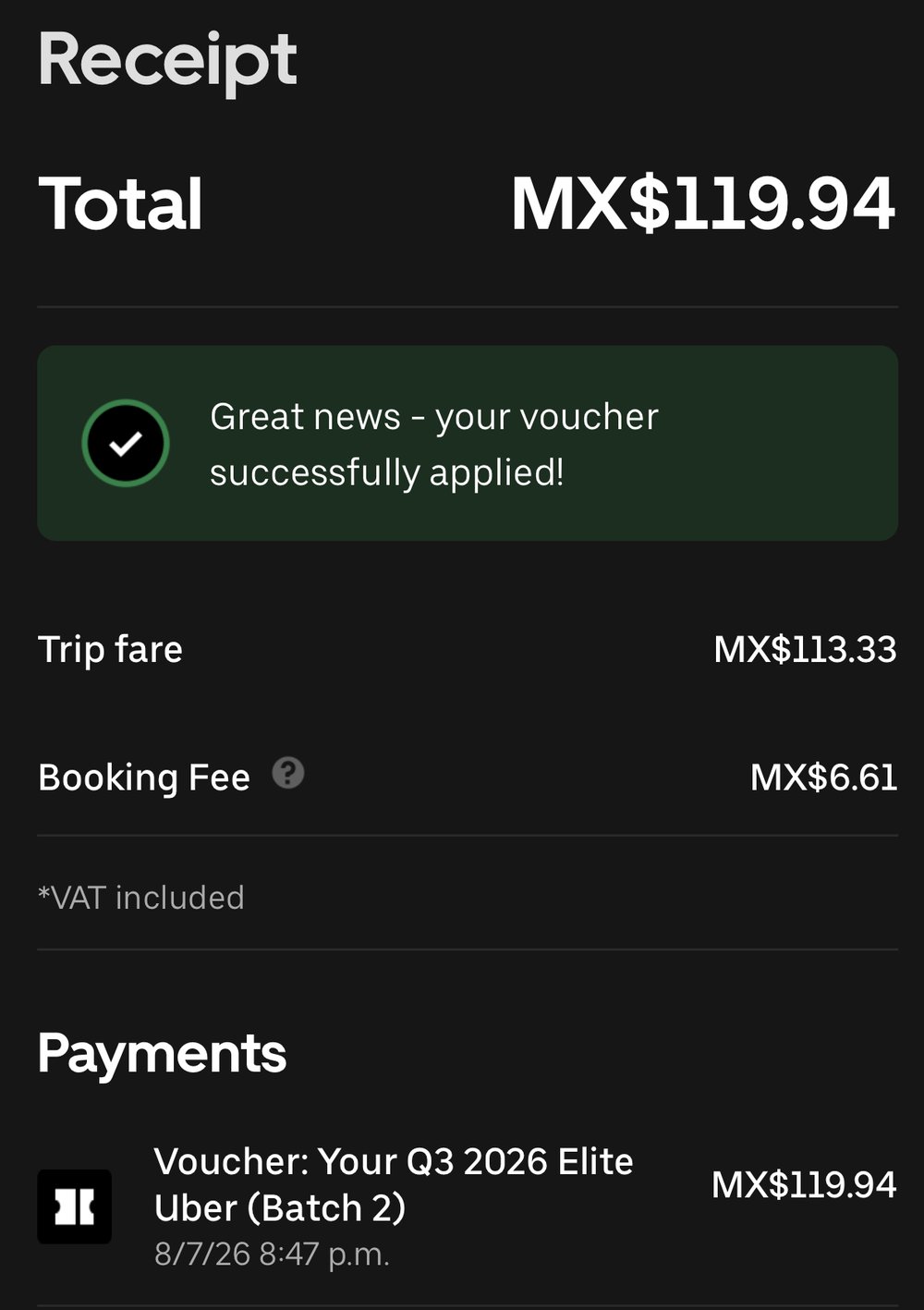
The US$200 annual Uber credit is what pushed me into Elite, but it isn't deposited all at once. It comes as four US$50 vouchers, with one available in each calendar quarter.
You have to log in to FoundersCard and request each voucher. Once claimed, the US$50 lands in your Uber wallet as credit and draws down progressively, so there's no need to burn it on a single ride or order. Unused amounts still expire at the end of the quarter, so this is only worth US$200 if you remember to claim it and spend at least US$50 with Uber every three months.
The vouchers work for both Uber rides and Uber Eats. They're issued in U.S. dollars and convert into the local Uber currency. I redeemed mine in Mexico without any trouble, which confirms the perk can be useful well beyond the U.S. and Canada.
I wouldn't assign the credit its full face value if it caused me to order extra meals or take rides I didn't need. In my case, the spending was already there. That makes the US$200 subtraction from the first-year fee reasonable, rather than a paper calculation built around changing my behaviour.
Business Benefits
FoundersCard still markets itself to business owners first, and this is the category where the long benefit list starts to feel deserved. A handful of the business benefits deserve particular attention from Canadian members.
- Stripe offers US$20,000 in fee-free processing for accounts outside the U.S., while U.S. accounts receive US$500 in credits instead
- Square offers US$10,000 in fee-free payments
- Google Workspace offers 20% off Business Standard and Plus plans for two years, with Canada explicitly eligible
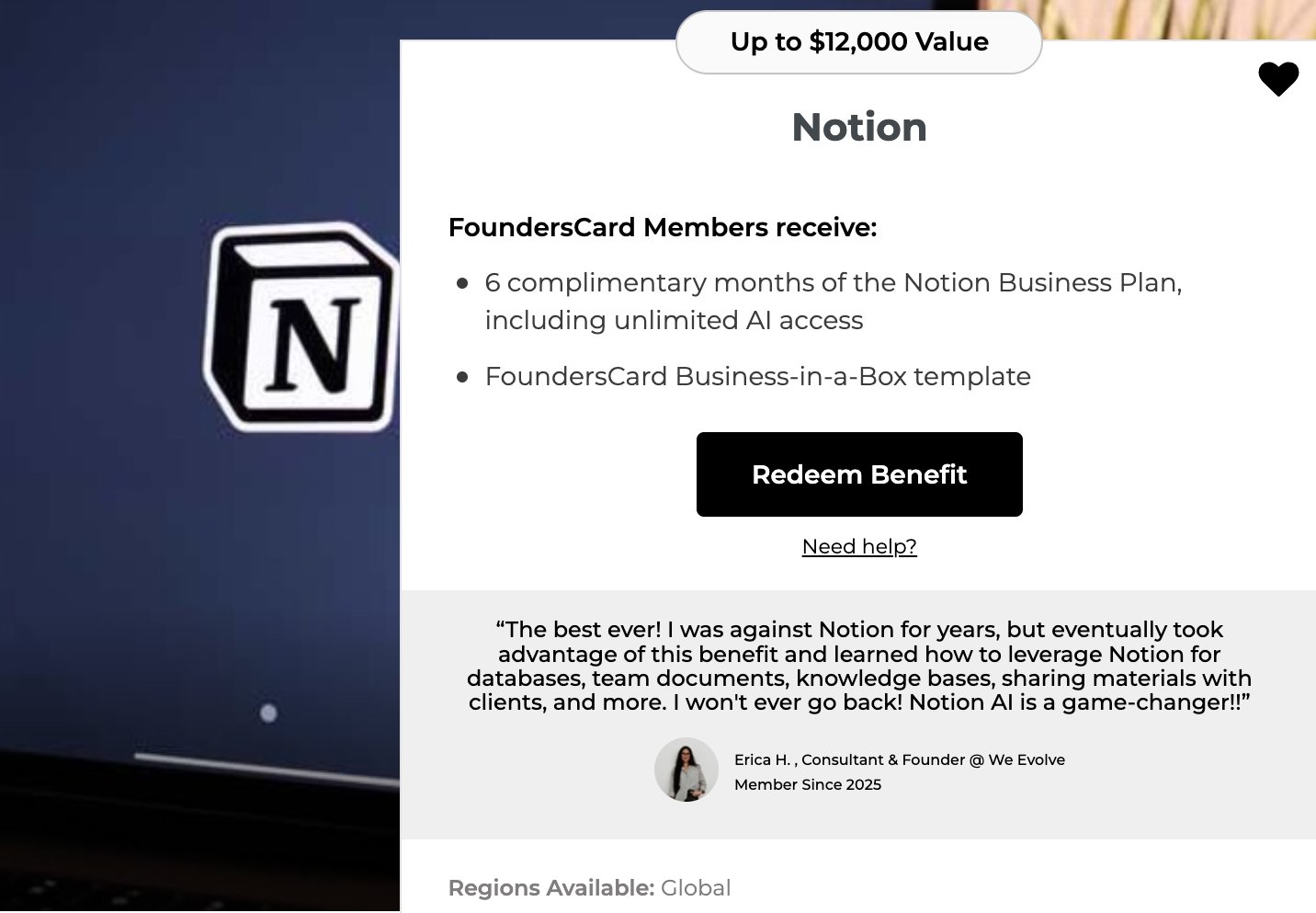
- Notion offers six months of its Business plan with unlimited AI for new Notion customers
- WeWork includes a complimentary day pass and up to 25% off, and I've already used my pass
- TripIt Pro is free for one year and then costs US$39 per year for three years, although I personally prefer Wanderlog
- ShipTime offers up to 67% off shipping to and from Canada
There's a long tail of offers from Microsoft, Dell, Lenovo, FedEx, UPS, DHL, coworking providers, and LinkedIn Premium. Whether those matter depends entirely on what your business already buys.
Elite membership also includes a companion pass that extends Charter-level privileges to a spouse or partner, along with a concierge offering five task hours per membership year. Then there's the black stainless-steel membership card, which is a mildly amusing artifact to keep in a wallet even though it can't pay for dinner.
Is FoundersCard Worth It?
At the pricing I received, the short answer is yes for the first year. I paid US$299 for Elite, and the Uber vouchers can return US$200 of value on spending I would have made anyway. That leaves an effective cost of about US$99.
At US$99, using even one worthwhile hotel or car rental status makes the experiment easy to justify. Hertz President's Circle was confirmed quickly, I used the WeWork pass, and I still have the Marriott challenge waiting for the year when it can help my lifetime status strategy.
The US$795 Elite renewal is a much harder decision, and I haven't made it yet. At that price, the Uber credit, Hertz President's Circle, and Marriott challenge have to keep earning their place. A collection of discounts I might use isn't enough.
There's also an obvious comparison with the American Express Platinum Card. A premium credit card can provide hotel statuses and lounge access, which FoundersCard entirely lacks, while also earning points on spending and offering a welcome bonus.
I see FoundersCard as a complement for a particular type of business traveller, not a substitute for a premium travel card. Its value is concentrated in a few statuses and business offers, and you need enough overlap with your existing spending to make the numbers work.
The skepticism around FoundersCard in 2022 was justified at the time, especially when much of the conversation centred on one exceptional Caesars benefit. At the discounted 2026 funnel prices, the answer has changed for the right person. It still hasn't changed enough to make the rack rate sensible.
Conclusion
I'm keeping FoundersCard Elite through the first year and will revisit it when the US$795 renewal approaches, watching for whether any retention pricing comes around. Without it, the membership likely isn't worth full price, especially when a premium credit card like the American Express Platinum Card delivers comparable hotel statuses, plus lounge access, at a lower cost.
Business owners who rent cars frequently, stay with the participating hotel programs, and enter through a free trial or discounted upgrade have the strongest case for joining. Travellers in regions where these loyalty statuses are much harder to earn may also find the bundle compelling. Anyone expecting lounge access or important airline status, or anyone considering paying the rack rate, should look elsewhere.

Jason thrives on connecting with the heart of a destination, seeking out experiences that go beyond the guidebooks.
First-year value
$336
Monthly fee: $15.99
• Earn 1,250 points per month upon spending $750 per month for 12 months




Member Discussion