
How Does the ALL Accor+ Explorer Stay Plus Free Night Benefit Work?

I've been an ALL Accor+ Explorer member for about half a year now, and the single benefit that keeps justifying the US$229 fee on its own is the Stay Plus free night. Two of them come with the membership each year, redeemable across 1,300+ Asia-Pacific hotels, and used right, one booking can cover the entire cost of the membership.
I did not want to stop at "this sounds good in theory," so I dug into how the new Stay Plus rules actually work after Accor changed them in October 2025, then booked one to see what came out the other side. This guide walks through what the benefit covers, where it doesn't apply, and how to think about the math from a Canadian perspective.
What Stay Plus Actually Gives You
Stay Plus is the headline benefit of ALL Accor+ Explorer, Accor's paid subscription program. Each year you get two certificates, and each certificate covers the cost of one free night when you book a stay of two or more consecutive nights at a participating Accor property in Asia-Pacific.
It works the way most "free night" perks do. You book two nights, one of them gets comped, and the free night always applies to the more expensive of the two. If rates are uneven across your stay (weekend pricing, peak season), Accor automatically optimizes the discount for you.
The certificates are valid at more than 1,300 hotels across Asia-Pacific, including Fairmont, Sofitel, Pullman, Mövenpick, Mercure, Novotel, MGallery, ibis, and the Ennismore lifestyle brands like Mondrian, Hyde, SLS, SO/, and 25hours. Notable absences include the Banyan Tree group, which Accor acquired but excluded from Stay Plus, and Pullman Maldives All-Inclusive Resort.

How the Free Night Is Calculated
The mechanic is simple. When you search a participating property for a two-night stay, you'll see two rate types: the regular rate and the Stay Plus rate. The Stay Plus rate quotes you the total cost minus the more expensive night.
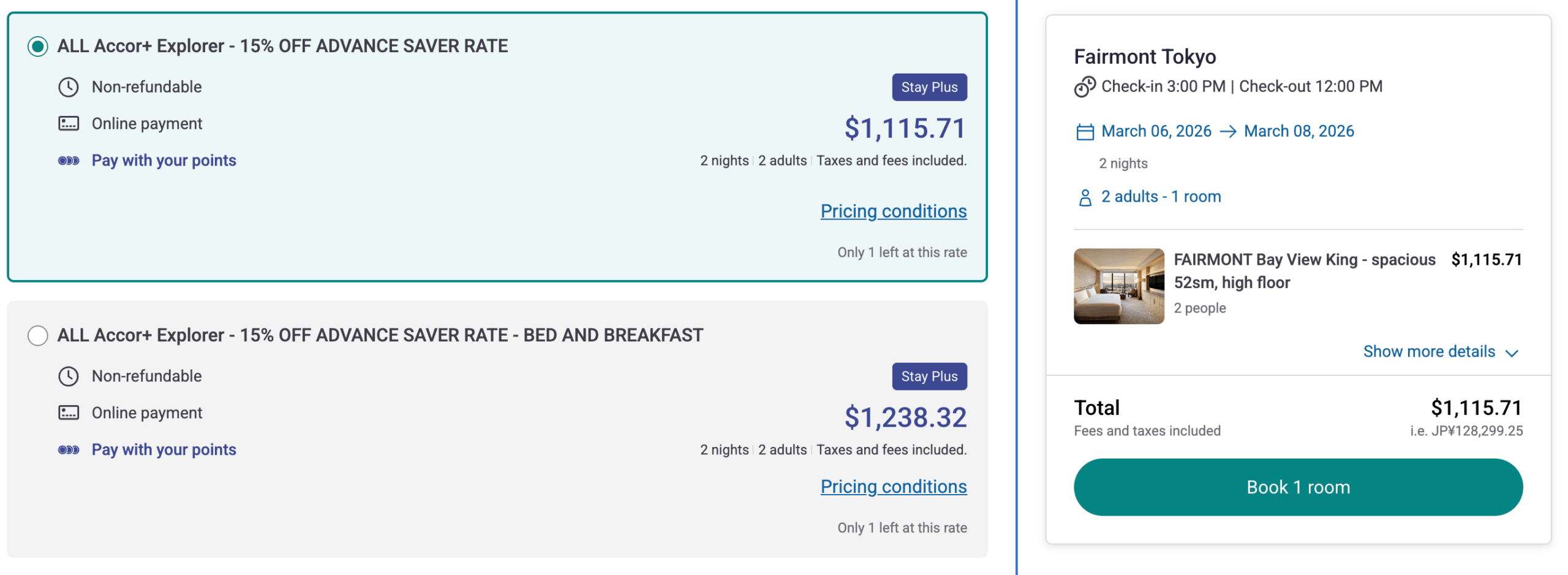
The free night always covers the night the property charges most for. If you're booking a Friday-Saturday stay at a hotel that prices Saturday higher than Friday, Saturday is the night that gets comped. If both nights are priced the same, you save 50% on the booking.
One detail that's easy to miss is that the certificate only covers the base room category that triggered the booking. If you want to upgrade to a higher room category (say, a Club room or a suite), you can do it, but you'll pay the full upcharge for the upgraded category. The certificate doesn't scale up with you.
Status nights still accrue on both the paid and the free night, which is a nice quiet upside if you're working toward Platinum or Diamond.
Booking a Stay Plus Certificate Step by Step
The booking flow is fairly mechanical, but the entry point is non-obvious. The Stay Plus rate doesn't show up on the regular Accor booking flow at accor.com. You have to go through the dedicated Explorer portal.
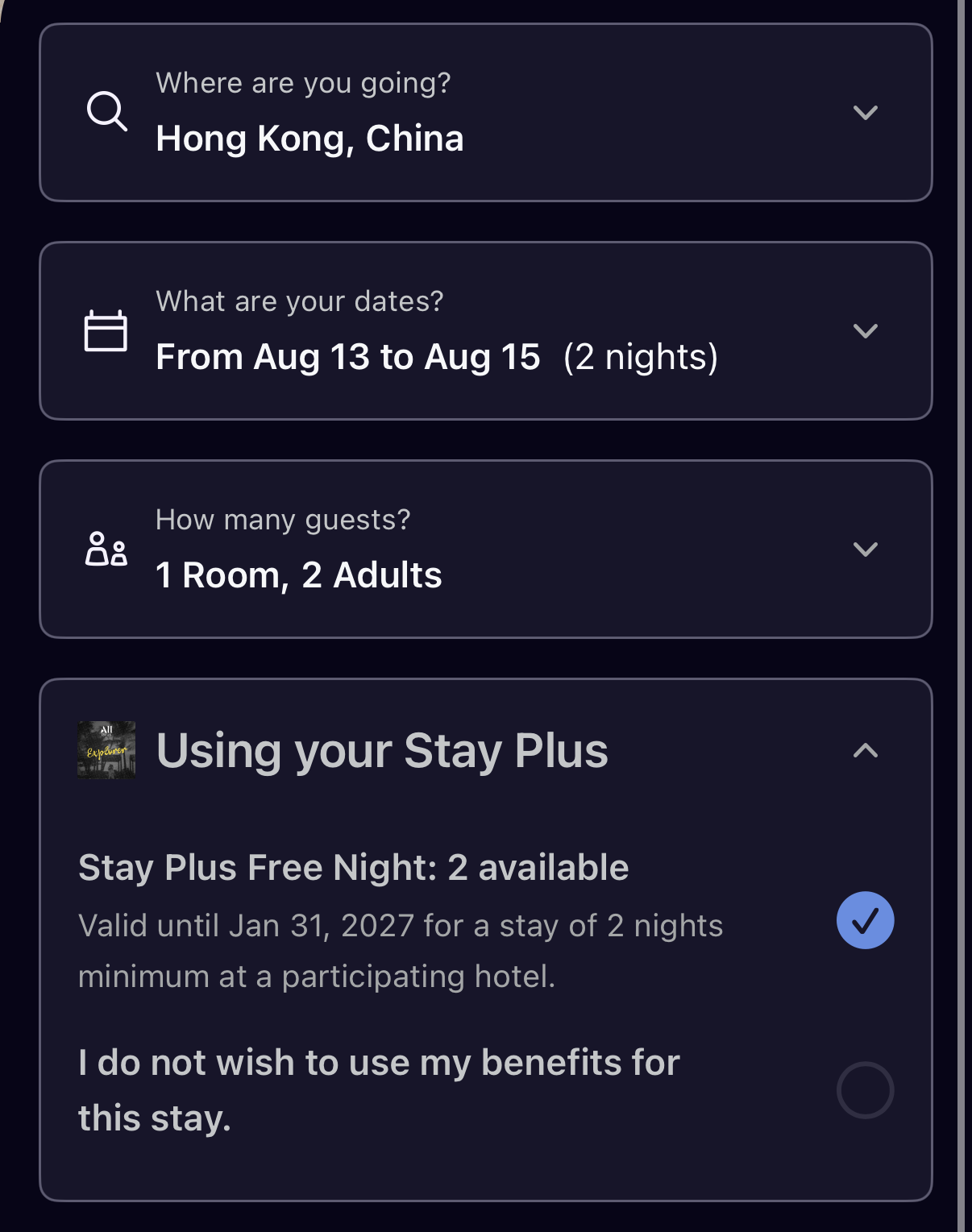
Here's the path I've used:
- Sign in to your ALL account at accor.com and confirm you have active Stay Plus certificates under your Explorer membership
- Use the dedicated Stay Plus search at accorplus.com, since searching from the regular Accor website won't surface Stay Plus rates
- Enter your destination, dates (minimum two nights), and number of guests
- Filter for properties showing the Stay Plus rate badge, since not every Accor property in a city will participate
- Compare the regular rate vs the Stay Plus rate to confirm the savings on your dates
- Book directly through the portal. The certificate is automatically applied at checkout. You don't manually attach it
- Pay for the paid portion of the stay with a credit card. You cannot apply ALL Reward Points toward the paid night

Once the booking is confirmed, you'll see one of your two certificates marked as used in the portal. The other remains available until you book it or until your membership year expires, whichever comes first.
What Changed in October 2025
If you've heard about Stay Plus before October 2025, the program has changed materially. Accor unified its previous regional Accor Plus tiers into a single global ALL Accor+ Explorer membership on October 1, 2025, and the Stay Plus rules came along with the consolidation.

The biggest change is that free nights are no longer standalone. Under the old program, certain tiers let you book a free night by itself with no paid night required. Under the new rules, every Stay Plus certificate requires at least one paid night, with a minimum two-night stay, and the cert covers the more expensive of the two.
Accor also removed allocation limits. Previously, properties had a fixed number of Stay Plus rooms available on any given night, and those rooms could sell out even when standard rates were still available. The new program treats Stay Plus inventory the same as the property's standard rate. If the hotel is available, your certificate works. The trade-off is that blackout dates still exist, and capacity controls can still kick in around peak demand.
The net effect is easier availability with a harder mechanic. The minimum two-night requirement makes Stay Plus less useful for single-night business trips, but the broader inventory makes high-demand weekends and holiday stays much more bookable than they used to be.
Where Stay Plus Doesn't Work
A handful of properties and brands are excluded from Stay Plus, and the list matters if you're targeting specific destinations.
Two are fully excluded. The Banyan Group (Banyan Tree, Angsana, and Garrya) was grandfathered out when Accor acquired the brand, and Pullman Maldives Maamutaa All-Inclusive Resort is excluded as a single-property exception.

Several other brands and destinations bump the minimum to three nights instead of the usual two. On the brand side, that includes Art Series, Peppers, Quay West, Grand Mercure, The Sebel, Mantra, and BreakFree, mostly Australia and New Zealand properties. On the destination side, stays in Fiji, French Polynesia, and the Maldives also trigger the higher minimum regardless of the property.
The three-night-minimum rule effectively makes Stay Plus less useful at the most aspirational resort destinations, which is no accident. Hotels with year-round demand pressure tend to push the minimum stay higher to extract more revenue per certificate redemption.
Blackout dates are property-specific and aren't published in one centralized list. Your best bet is to check directly in the booking tool. If Stay Plus rates don't appear on your dates at a property you know participates, blackouts are usually why.
The Fine Print Worth Knowing
A few more rules are worth absorbing before you book. The paid night cannot be covered with ALL Reward Points, so redemption stays don't trigger Stay Plus, even though you can still earn points and benefit from member rates on the paid portion. Suite Night Upgrades also cannot be combined with Stay Plus bookings, so any SNUs in your account are better saved for non-Stay Plus stays.
The certificate has to be attached at booking time through the portal, which means walk-in bookings won't qualify. Certificates are also non-transferable, meaning the Explorer member needs to be a staying guest on the reservation. Consecutive Stay Plus stays at the same property require at least one non-Stay Plus night between them, so you can't chain two certificates back to back at the same hotel for an effective four-night stay at the price of two.
The most important rule is that both the booking and the stay must be completed before your membership expires. If your Explorer year runs out on September 30, you cannot book a stay that checks out on October 1. This trips people up more than the others, and it's a notable difference from credit card free-night certificates, which are usually valid as long as the booking date falls within the validity window. With Stay Plus, the checkout date is what counts.
Is Stay Plus Worth It for Canadians?
For Canadians, the math depends almost entirely on whether you have Asia-Pacific trips already on your calendar. Stay Plus is region-locked, and unlike the rest of the Explorer benefits (15% off global rates, instant Gold status, Red Hot Rooms), it cannot be redeemed at Canadian Fairmonts or anywhere in Europe or the Americas.
If you've got a Tokyo, Bangkok, Singapore, Sydney, Bali, or Phuket trip lined up, a single Stay Plus redemption at a higher-tier property will usually cover the entire US$229 (about $309 CAD) membership cost. A two-night Fairmont stay in any of those cities at $400 (CAD) per night becomes effectively $200 (CAD) per night with the cert applied, and you still earn ALL points and status nights on top.

If you don't travel to Asia-Pacific, the math gets harder. The rest of the Explorer package is fine but not transformative on its own. The 30 status nights credit gets you Gold, which is a modest upgrade over base ALL membership, and the global 15% off flexible rates is real money only on properties that aren't already running aggressive sale pricing. Without Stay Plus carrying the value proposition, the membership becomes a tough call.
My honest take is that Explorer is worth it for any Canadian who travels to the Asia-Pacific region at least once a year and is willing to plan one trip leg around an Accor property. Otherwise, skip the membership and book Accor stays through Accor HERA via a travel advisor for the breakfast and credit benefits instead.

Will Other Hotel Chains Follow This Model?
Stay Plus sits inside a paid-membership model that's been comparatively rare in the major hotel programmes. Hyatt, Marriott, and Hilton all gate their elite status behind nights, spend, or a co-branded credit card, none of which are available equally to everyone.
Accor is taking a different approach. Anyone with an internet connection and US$229 can buy Gold status, two Stay Plus certificates, dining discounts, and 15% off flexible rates worldwide, regardless of where they live or what their credit history looks like. There's no underwriter in the loop, no regional eligibility, no FICO score check, no annual minimum spend tracked across a credit card.
For Accor, the appeal is obvious. Subscription revenue is predictable, the member is locked in for a year, and the use-it-or-lose-it free night structure pushes incremental bookings the program would not otherwise capture. InterContinental Ambassador has been running a similar BOGO weekend-night structure for years at a similar price point, and it has not been Hyatt or Marriott's style to follow suit. The success of Accor's reframe might change that calculus.

The risk is status inflation. ALL Gold status used to mean 30 elite-qualifying nights of actual loyalty. Now anyone willing to pay US$229 gets the same tier instantly. When everybody is Gold, nobody is Gold, and the existing pool of members who spent real nights to earn the tier has less reason to keep chasing it. Diamond, which still requires €10,400 in pre-tax stays, may end up as the only tier that retains real signalling value.
My read is that Accor's model is the right direction, but it needs guardrails. Either keep paid-tier benefits a step below earned-tier benefits, or accept that mid-tier status is now a paid product and let the real loyalty rewards live higher up. The current setup, where paid Gold and earned Gold are indistinguishable, is the worst of both worlds.
Conclusion
Stay Plus is the rare paid-hotel-benefit that pays for itself in a single redemption, and the October 2025 reset made it easier to use rather than harder. The trade-off is that it's now squarely an Asia-Pacific perk, with a hard two-night minimum and a hard-coded "must stay before membership expires" deadline.
If you're a Canadian with a Tokyo, Singapore, or Bali stay on the books, this is probably the cheapest free-night certificate in the points world. If you're not, the rest of Explorer doesn't quite carry the membership on its own, and the smarter play is to book through a travel advisor for the upscale Accor properties you actually want to stay at.
I'll keep using my certs and reporting back. The model is interesting enough that I expect more programmes to test paid memberships over the next two to three years, and I'd rather lock in a benefit while it's still differentiated than wait for the rest of the industry to catch up.

Jason thrives on connecting with the heart of a destination, seeking out experiences that go beyond the guidebooks.

First-year value
$336
Monthly fee: $15.99
• Earn 1,250 points per month upon spending $750 per month for 12 months




Member Discussion