The Complete Guide to Austrian Airlines Business Class
Last updated February 25, 2026
Austrian Airlines may not generate the same excitement as its flashier Lufthansa Group siblings, but it has a compelling case as one of the most practical business class options for Canadian travellers.
The Austrian flag carrier operates from its Vienna hub – a gateway to Central and Eastern Europe that's difficult to replicate through other Star Alliance carriers – and releases some of the most generous business class award availability in the alliance.
For Canadians, the appeal is straightforward: Austrian operates direct Montreal–Vienna service, bookable through Aeroplan with zero fuel surcharges.
The airline is in the midst of a fleet transformation from aging Boeing 777s and 767s to Boeing 787-9 Dreamliners, and its signature DO&CO catering – complete with Flying Chefs who prepare meals onboard – adds a distinctly Viennese touch that sets it apart from other European carriers.
In this guide, we'll cover the Austrian Airlines business class product across its fleet, the airline's route network and Canadian service, how to book with points, and why this understated carrier deserves a place in your Miles & Points strategy.
The Austrian Airlines Business Class Experience
Austrian's business class blends the efficiency of the Lufthansa Group with a distinctly Austrian identity – think Viennese café culture, DO&CO gastronomy, and an understated elegance that reflects the country's heritage. Here's what to expect.
Ground Experience
In Vienna, Austrian operates its own Business Lounge in Terminal 3 – a modern space with hot and cold buffets, a full bar, shower facilities, and comfortable seating areas. The food reflects Austrian cuisine, with dishes like Wiener Schnitzel, strudel, and freshly prepared salads.
The atmosphere is typically relaxed and uncrowded, a benefit of Vienna's manageable airport size compared to Frankfurt or Munich.
For Star Alliance Gold members (including Aeroplan 50K and 75K), the Senator Lounge offers a quieter experience with an upgraded food and drink selection.
The lounge network in Vienna is smaller than Lufthansa's Frankfurt operation, but the quality is solid and the airport itself is efficient and easy to navigate.
From Montreal, Austrian business class passengers can access the Air Canada Maple Leaf Lounge or other Star Alliance-affiliated lounges at Montréal–Trudeau.
Seat
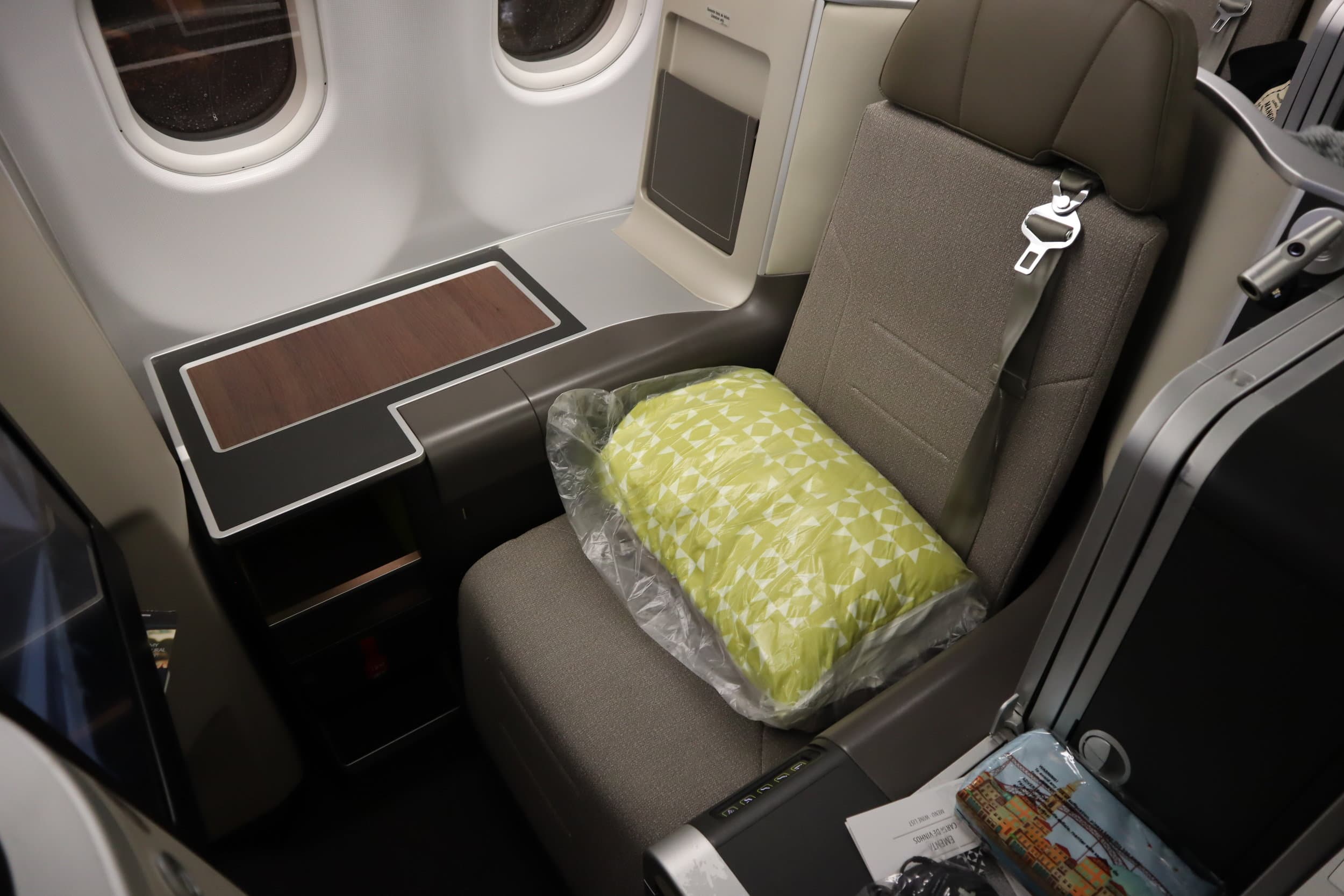
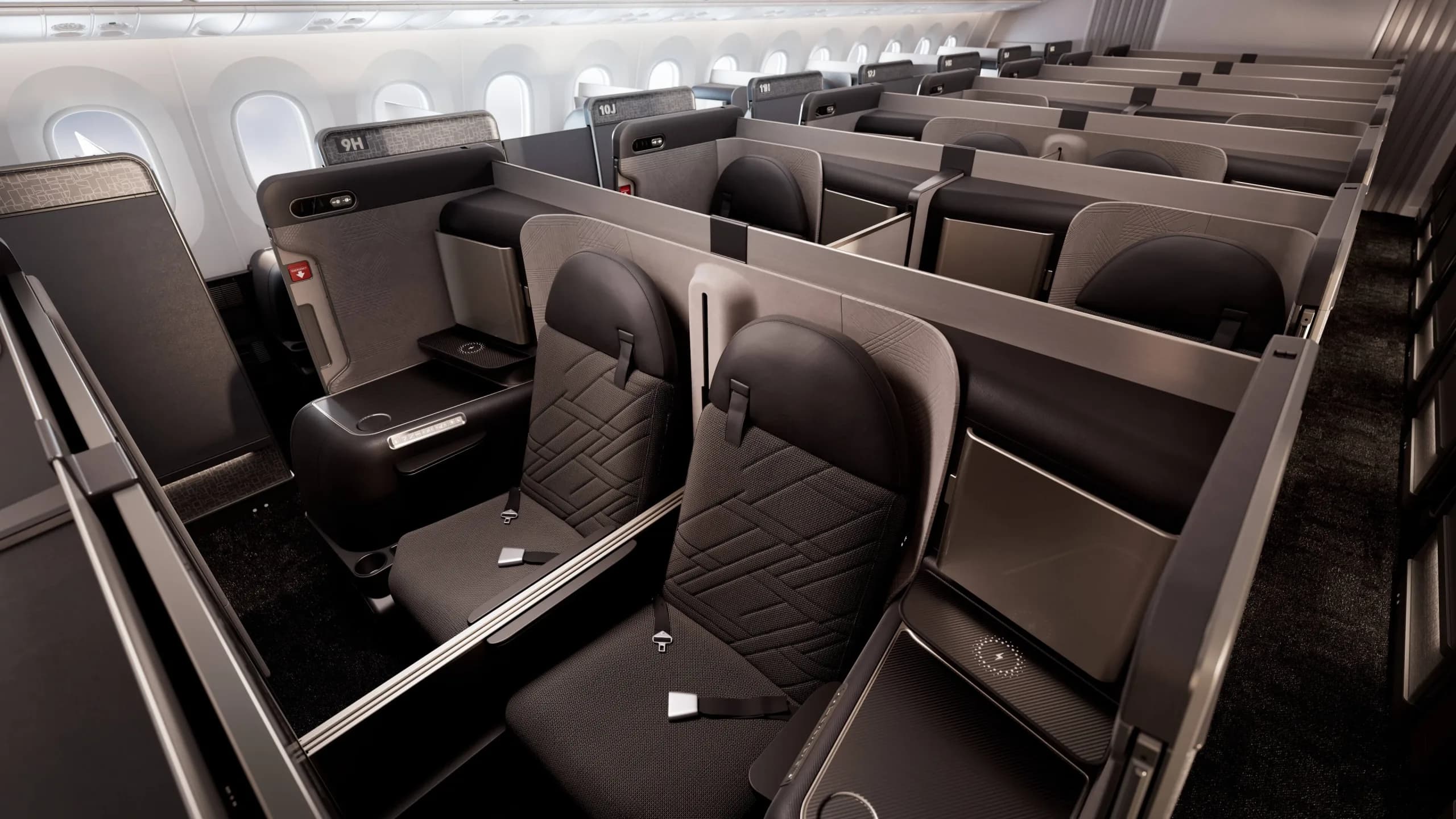
Austrian's business class is in transition. The airline operates three aircraft types on long-haul routes, each with a different seat product – and the gap between the best and worst is significant.
We'll break down each variant in the aircraft section below, but the key distinction is between the newer 787-9 Dreamliner (Collins Aerospace Super Diamond in a consistent 1-2-1 layout) and the legacy 777-200ER (Thompson Vantage in an alternating 1-2-1 and 2-2-2 layout that doesn't guarantee direct aisle access for all passengers).
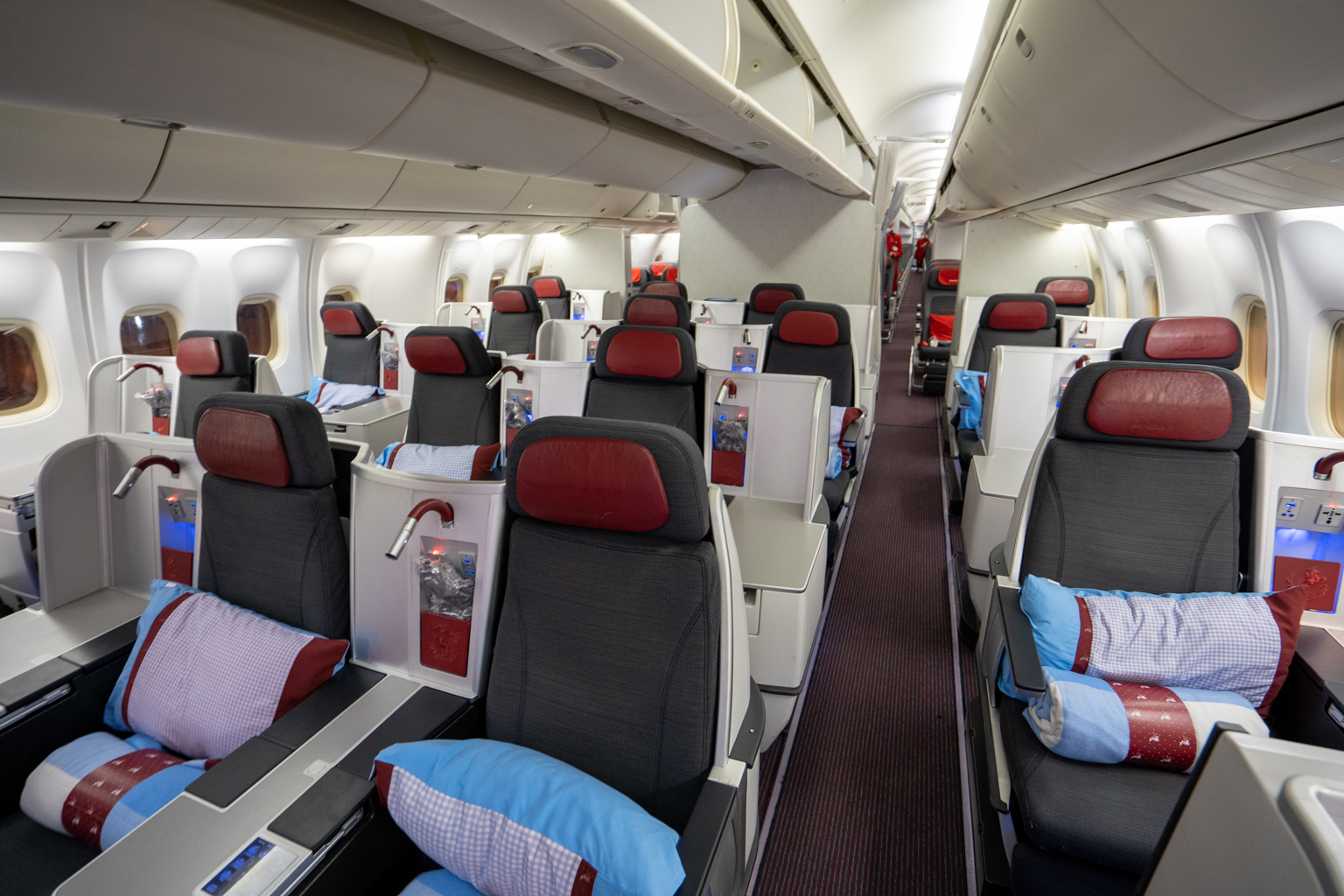
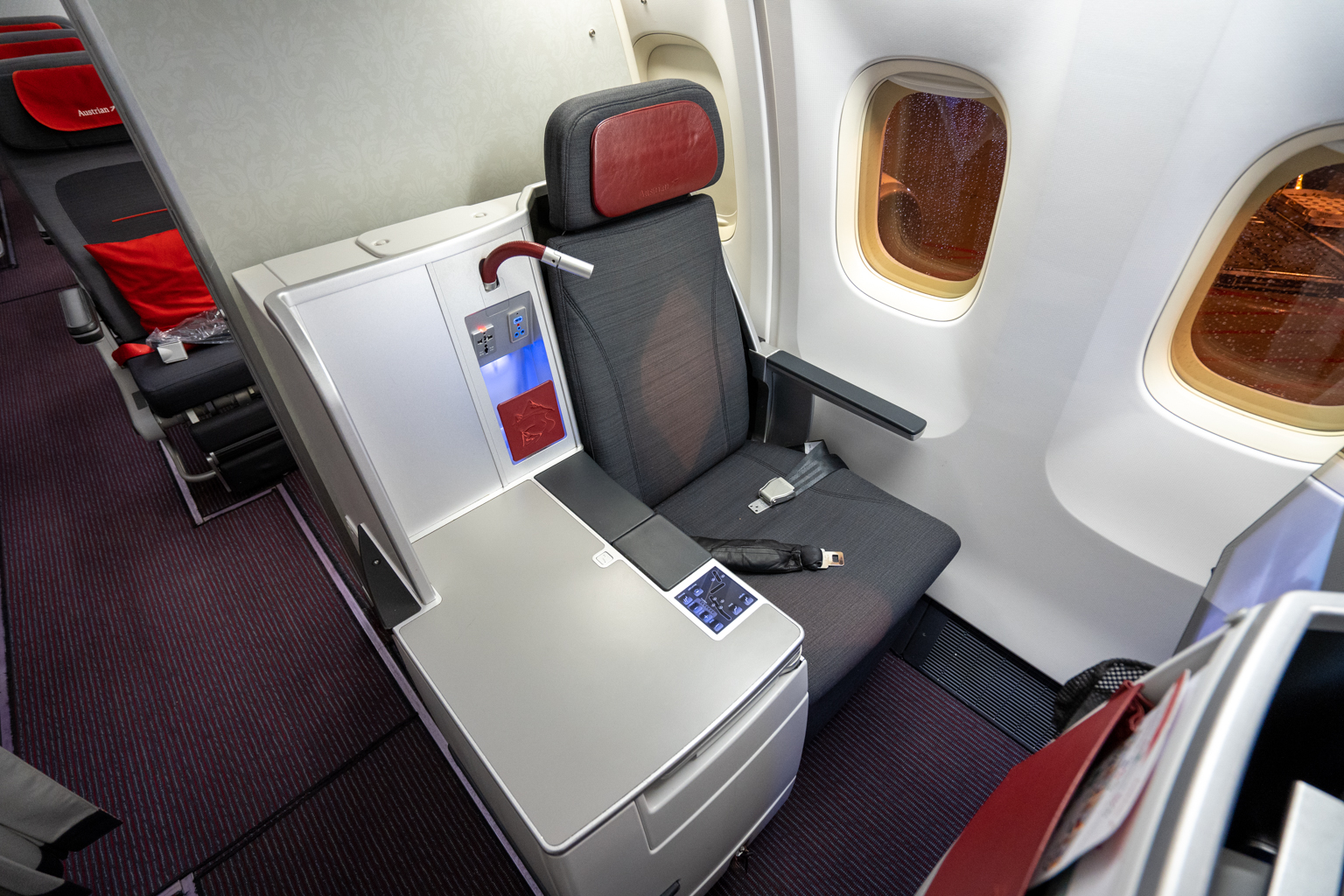
All Austrian long-haul business class seats are fully lie-flat, and the staggered designs create reasonable privacy for an open cabin. But there are no doors, no suites, and no cutting-edge features like wireless charging or Bluetooth audio.
Austrian's hard product is functional rather than flashy – the real differentiation comes from the soft product.
Food and Drink
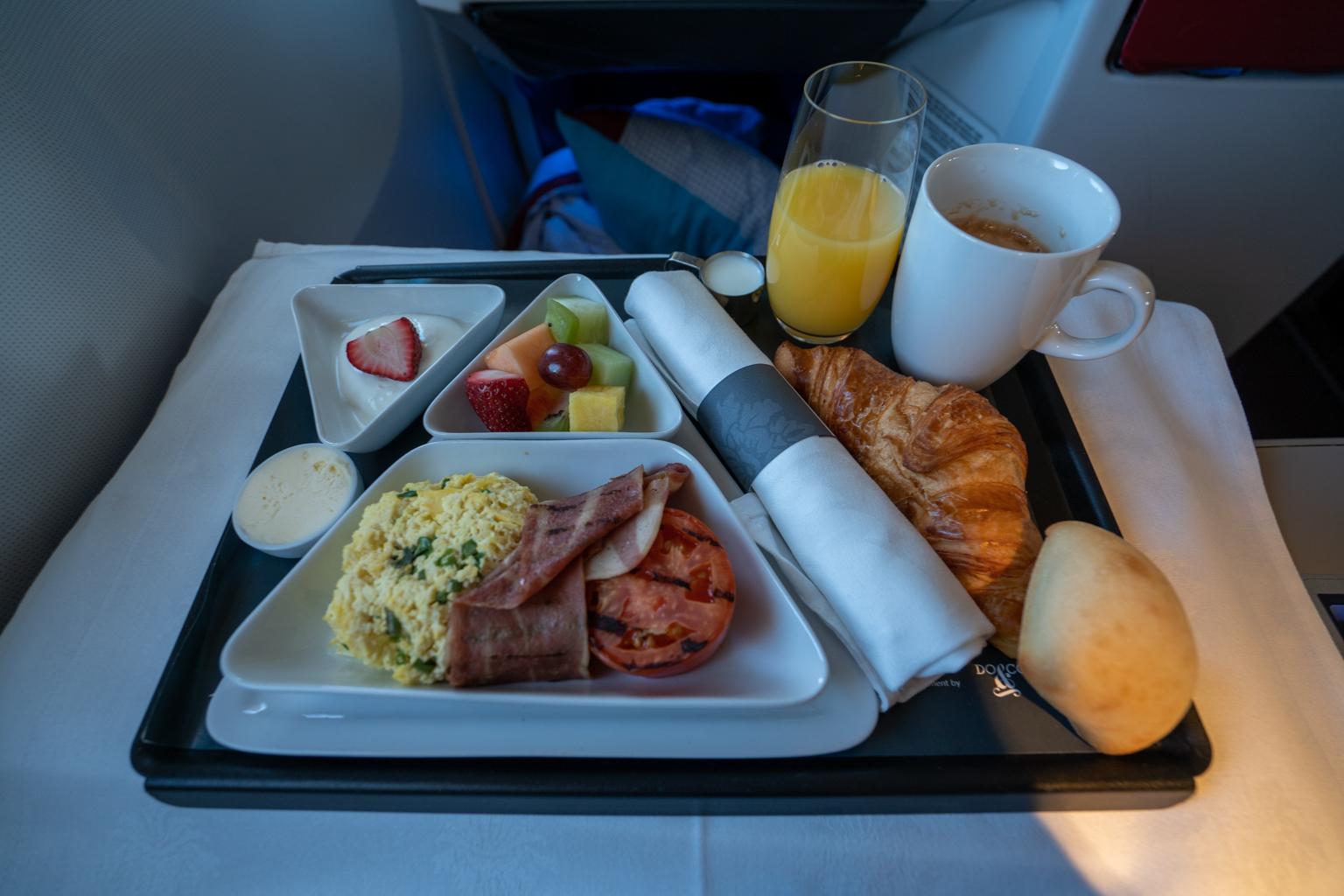
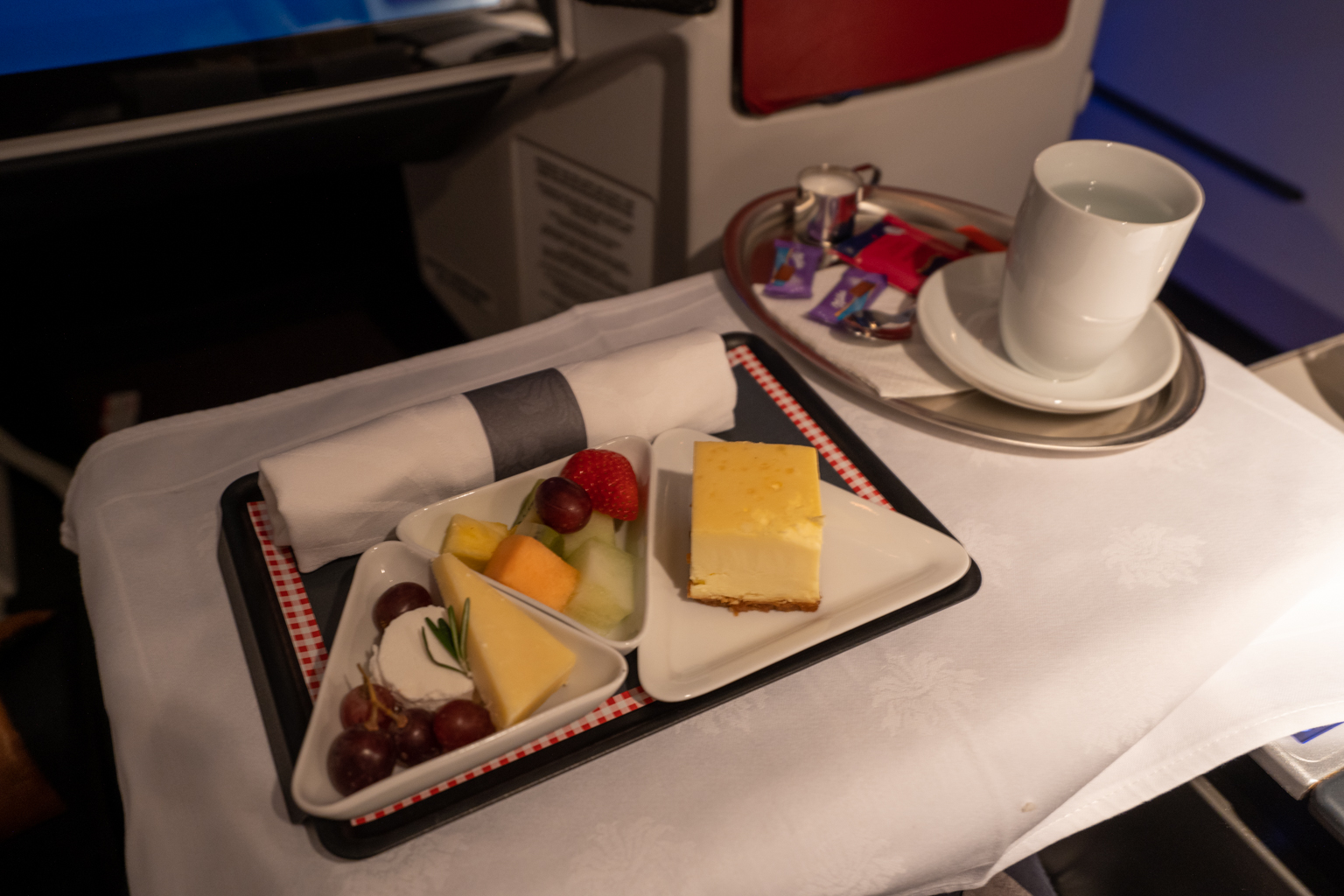
This is where Austrian genuinely stands out. The airline's catering is handled by DO&CO, the Vienna-based premium caterer that also supplies Turkish Airlines and the Lufthansa First Class Terminal in Frankfurt.
In April 2025, Austrian reintroduced its Flying Chef programme – fully qualified DO&CO chefs who travel onboard to prepare and plate meals in the galley, ensuring a level of freshness and presentation that pre-prepared airline catering can't match.
Menus feature Austrian and international cuisine, with dishes like Tafelspitz (boiled beef with apple-horseradish sauce), Wiener Schnitzel, and seasonal European options.
The presentation is individual plating rather than tray service, and the quality is noticeably better on flights departing Vienna than on return sectors catered from overseas stations.
The signature offering is Austrian's Viennese coffee service – a dedicated menu of speciality coffees made with Julius Meinl beans, including the Wiener Melange (espresso with steamed milk and foam), Einspänner (espresso topped with whipped cream), and Wiener Eiskaffee (iced coffee with vanilla ice cream).
It's a distinctive cultural touch that you won't find on any other airline.
The wine list features Austrian selections including Schlumberger sparkling wine alongside French champagne, and amenity kits are provided with WienerBlut skincare products from a traditional Viennese perfumery.
Austrian Airlines Business Class by Aircraft
Austrian operates three widebody aircraft types on long-haul routes, and the business class product differs meaningfully between them. The fleet is in transition – the 787-9 is the future, and the 767 is on its way out.
Boeing 787-9 Dreamliner (Newest Product)
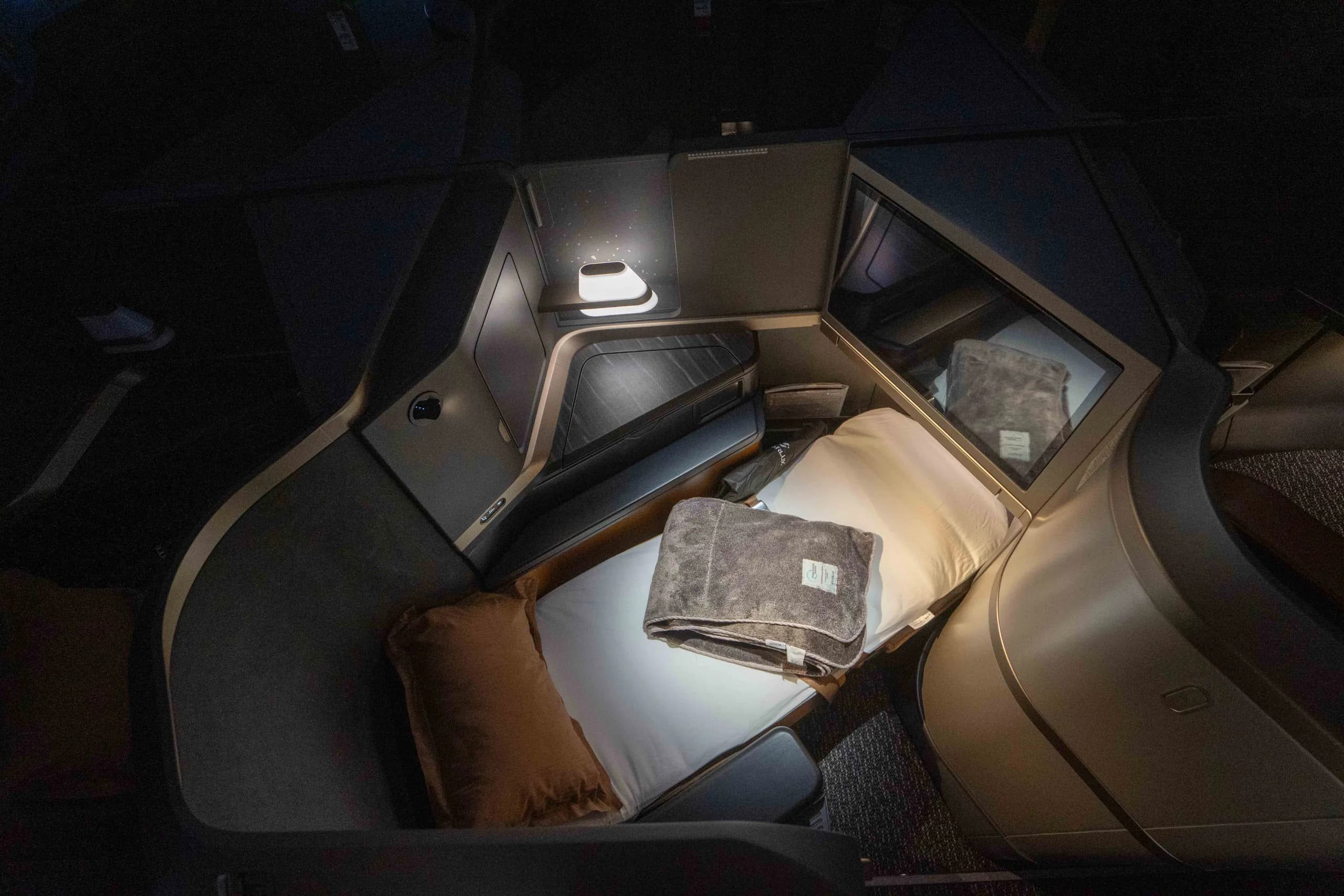
The 787-9 is Austrian's newest long-haul aircraft and the one you want to target. It features the Collins Aerospace Super Diamond seat in a consistent 1-2-1 reverse herringbone configuration with 26 business class seats – and critically, direct aisle access from every seat.
This is the first time in Austrian's history that every business class passenger can reach the aisle without disturbing a neighbour.
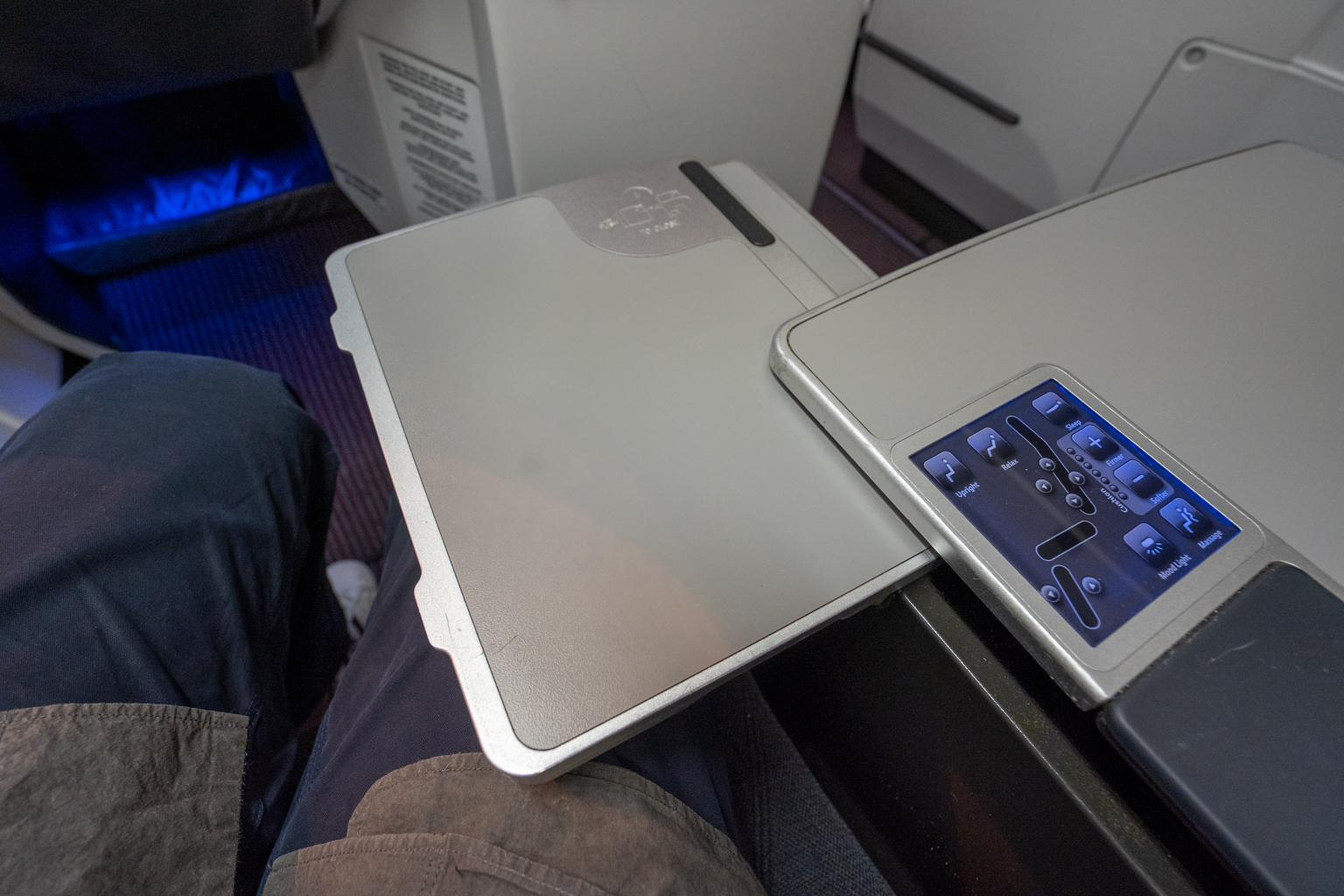
The Super Diamond is a well-known, reliable business class seat found across multiple carriers. Each seat converts to a fully flat bed with a tapered footwell, and the cabin finishes have been refreshed with Austrian branding and a modern aesthetic. In-seat power, USB ports, and a personal IFE screen are standard.
The 787-9 benefits from the Dreamliner's cabin technology – lower cabin altitude (6,000 feet equivalent), higher humidity, and larger electronically dimmable windows.
For overnight flights, the combination of a comfortable reverse herringbone seat and the Dreamliner environment makes for a noticeably better sleeping experience than the older aircraft.
Austrian currently operates two 787-9s (ex-Bamboo Airways), with three more arriving in 2026, two in 2027, and five more through 2028 – bringing the total to twelve. As deliveries continue, the 787-9 will progressively take over more routes, including the Montreal service.
Boeing 777-200ER (Current Workhorse)
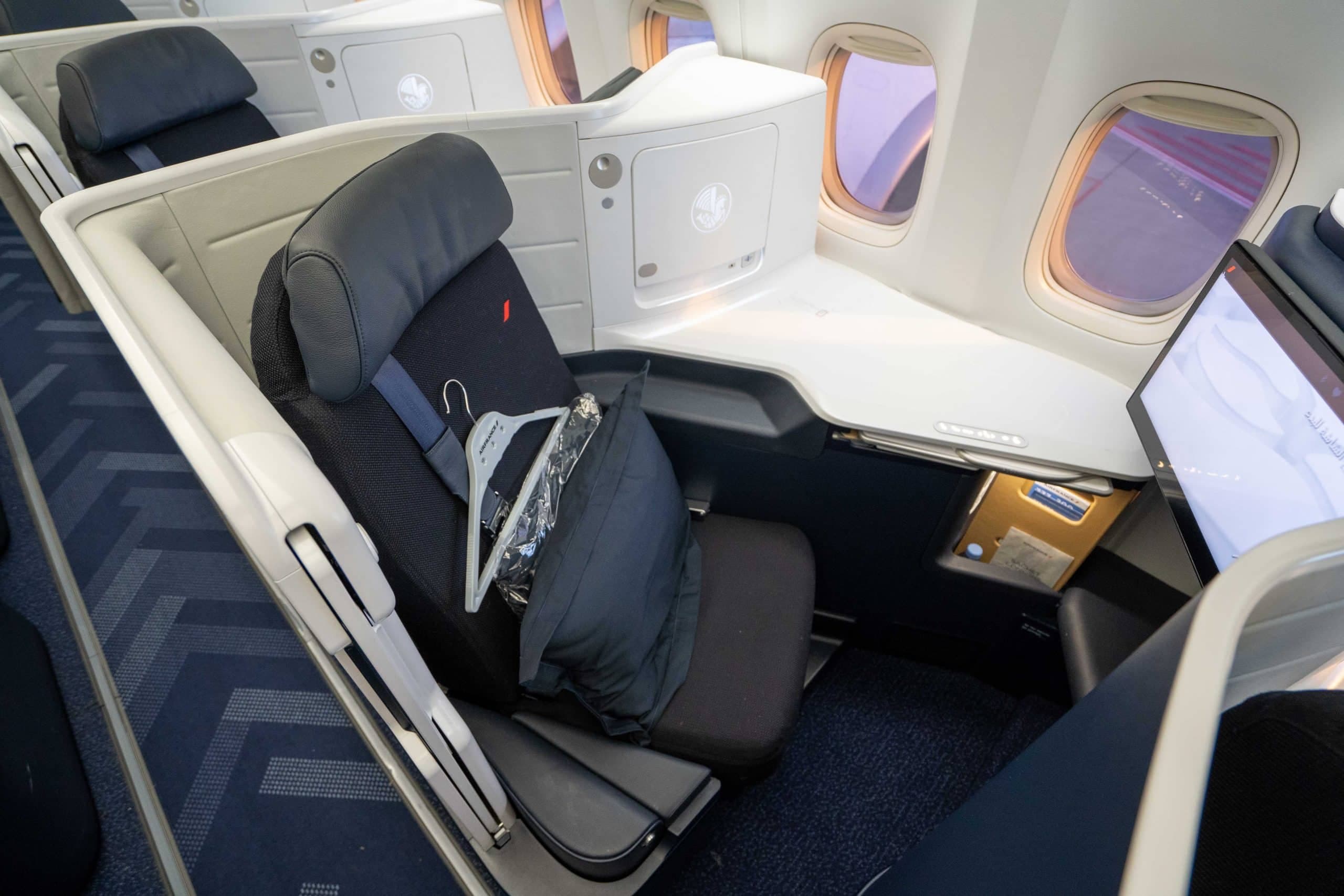
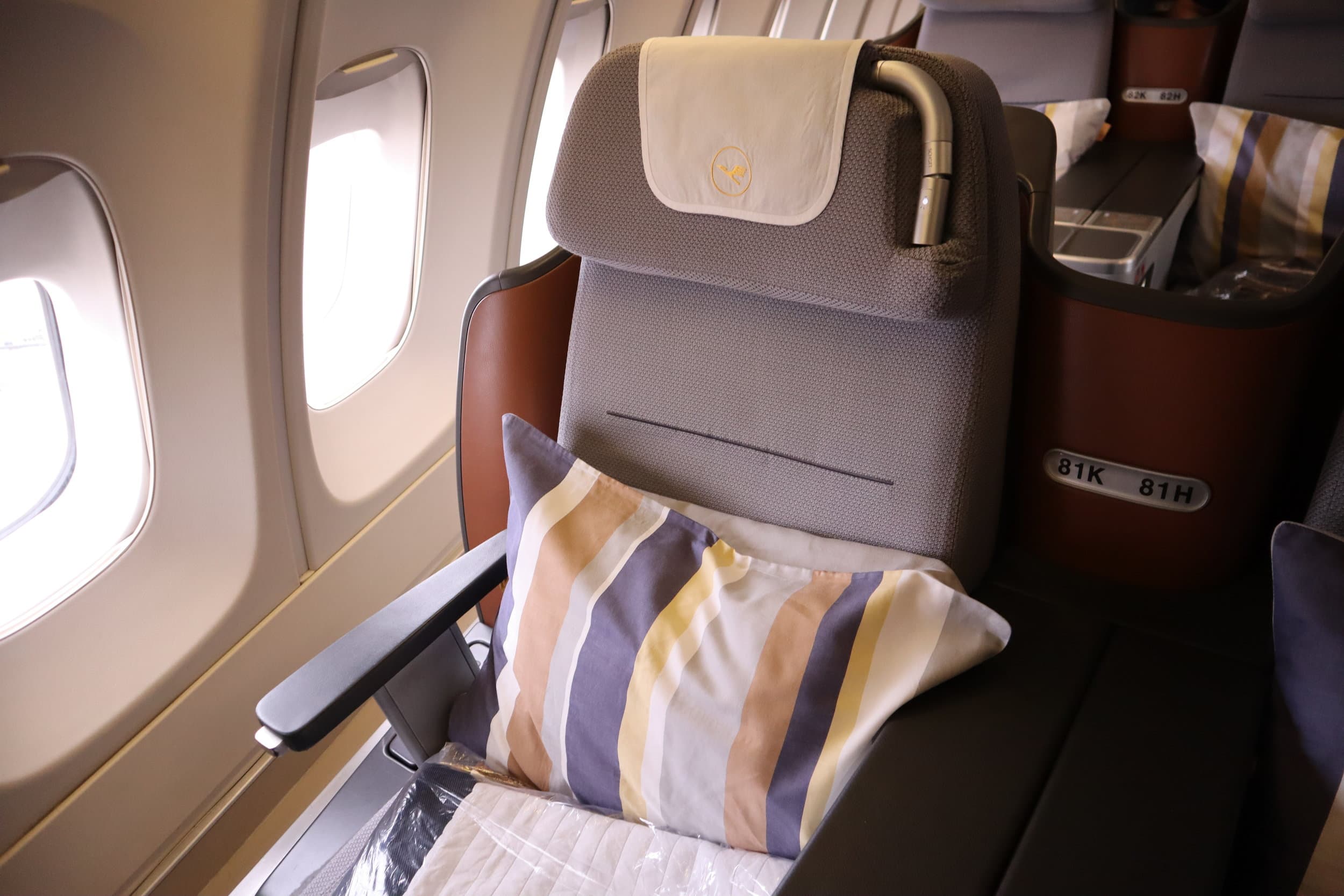
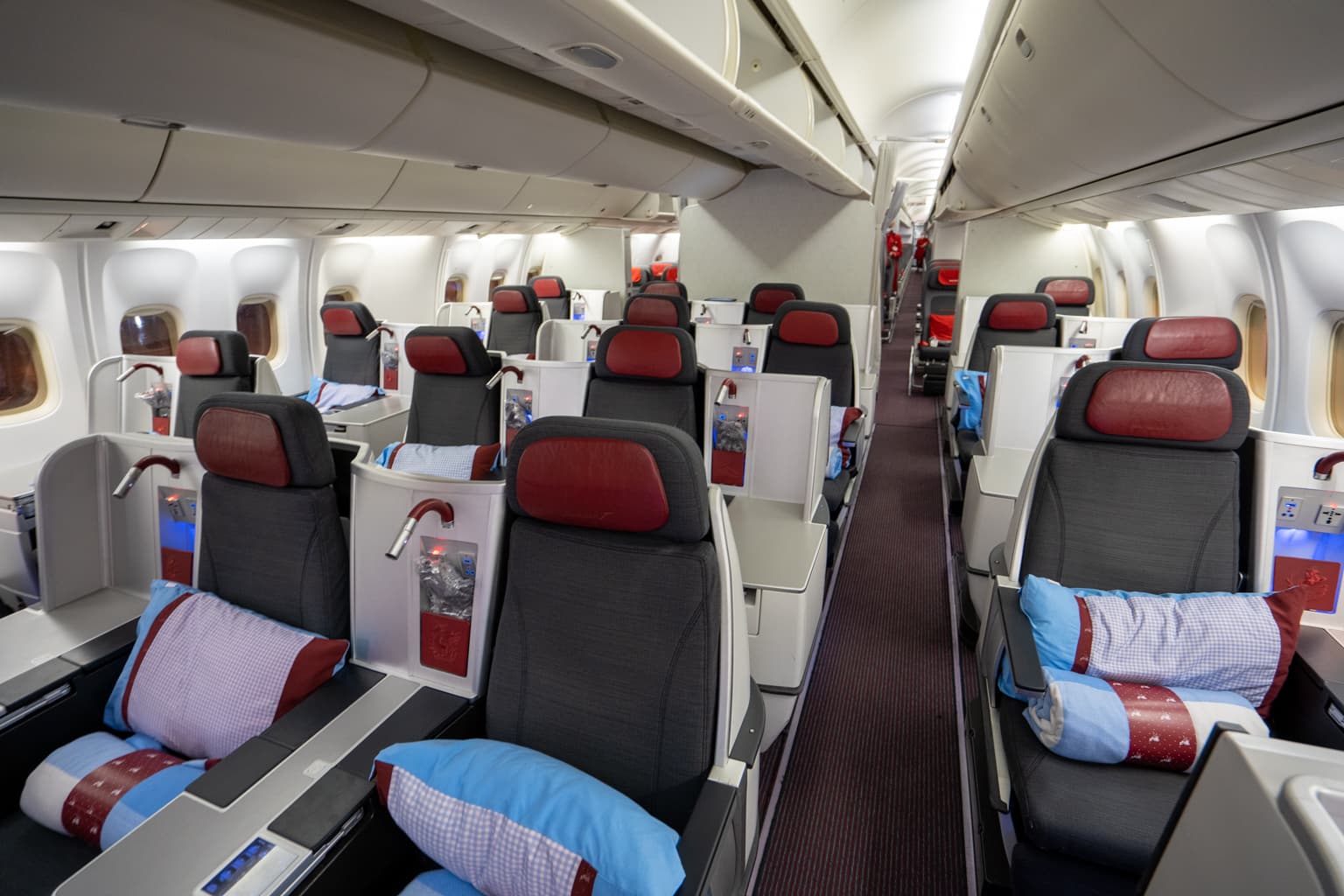
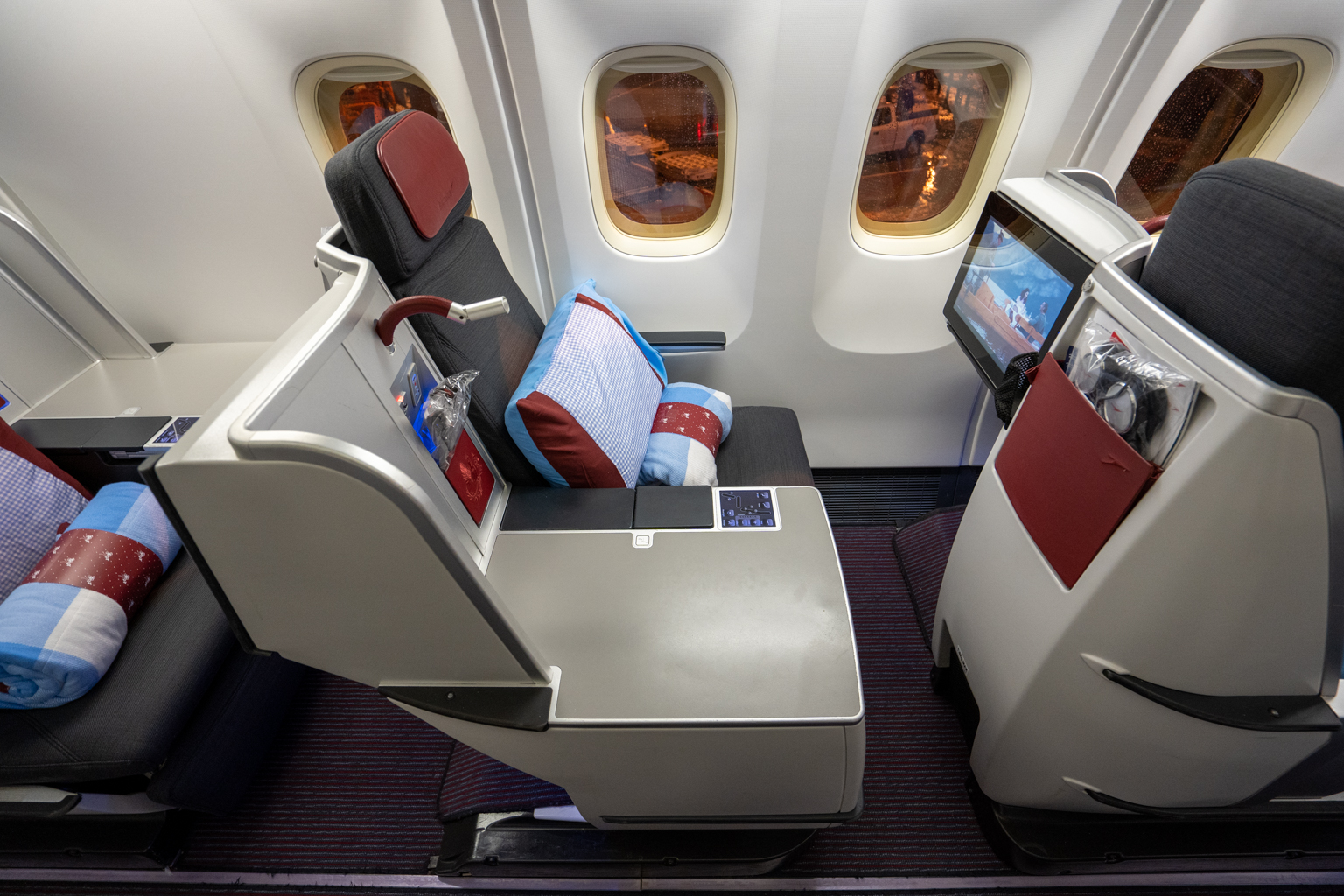
The 777-200ER is Austrian's primary long-haul aircraft, with seven in the fleet. The business class cabin features 40 Thompson Aero Vantage seats in an unusual alternating configuration – rows alternate between 1-2-1 (with direct aisle access) and 2-2-2 (without).
This means roughly half the seats in the cabin don't have direct aisle access, which is a significant drawback by modern standards.
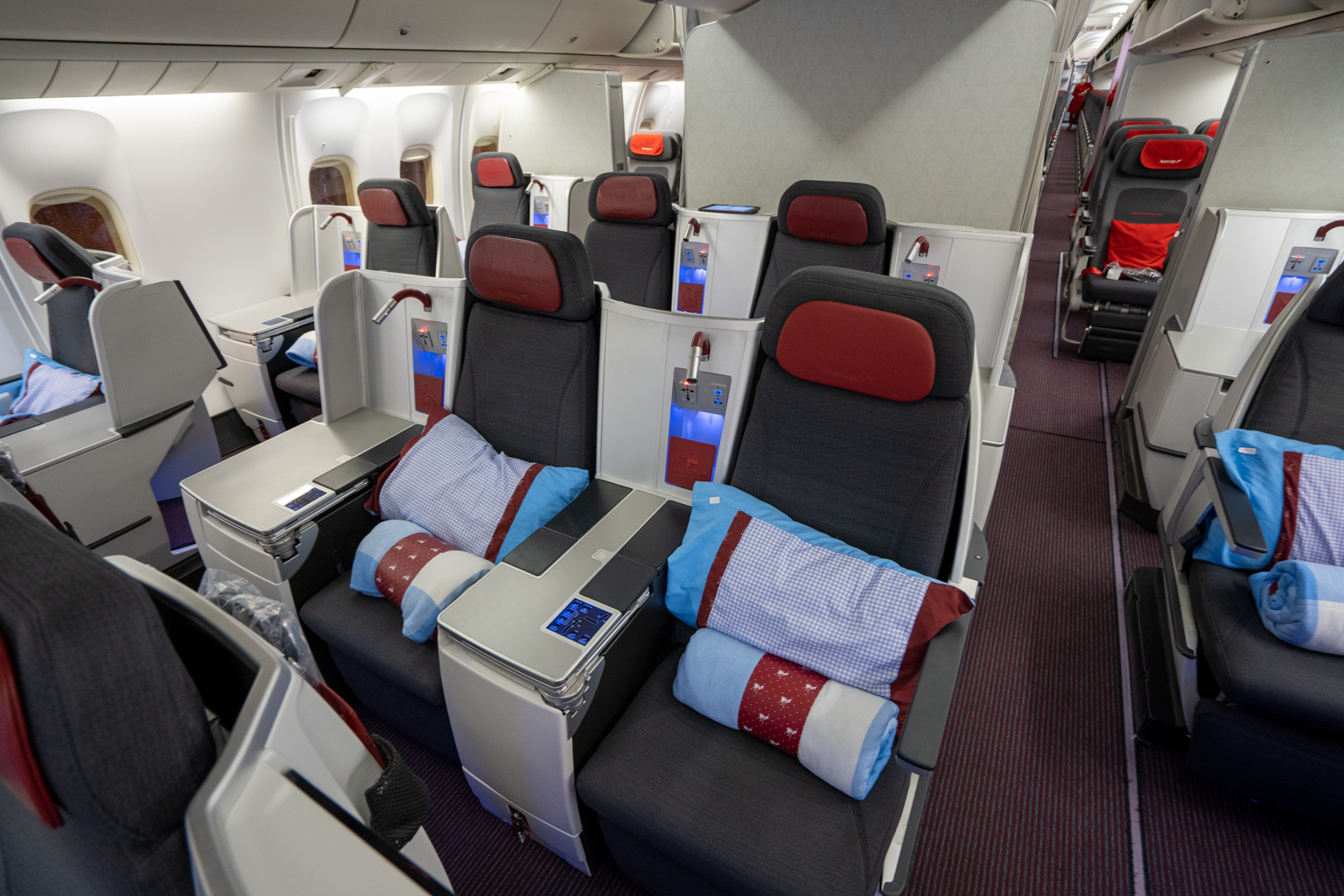
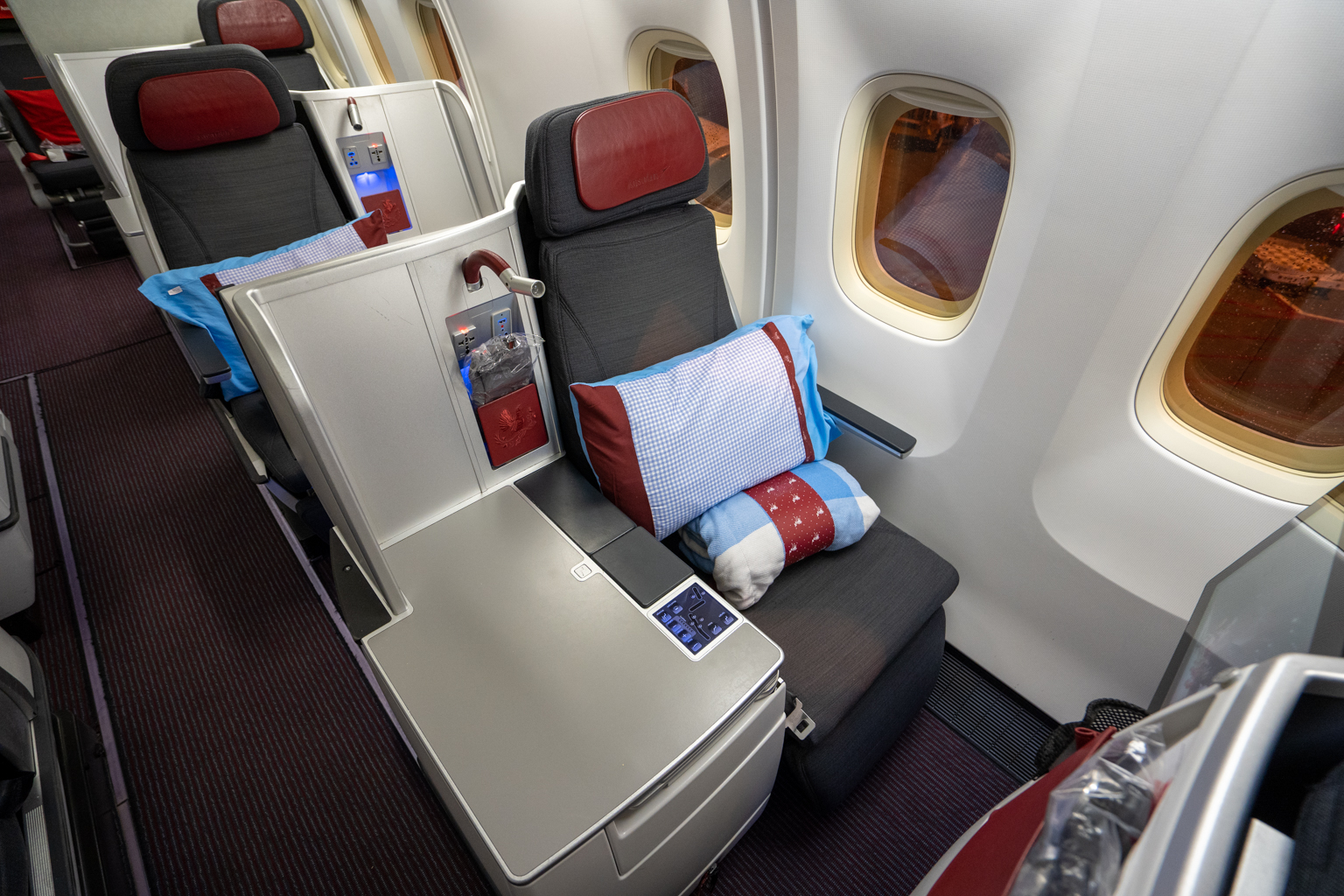
The coveted seats are the "throne seats" – solo window positions in the 1-2-1 rows (odd-numbered rows: 1A/1K, 3A/3K, 5A/5K, 7A/7K). These are positioned directly next to the window with extra surface space and meaningful privacy. Centre pairs in the 1-2-1 rows are suitable for couples. Avoid the 2-2-2 rows if privacy and aisle access matter to you.
Each seat has a 78-inch bed length, 20-inch width, and a 15-inch IFE screen. The seats are showing their age – the hardware is roughly a decade old – but the lie-flat bed is serviceable and the staggered design creates more separation between passengers than a traditional open cabin.
Boeing 767-300ER (Being Retired)
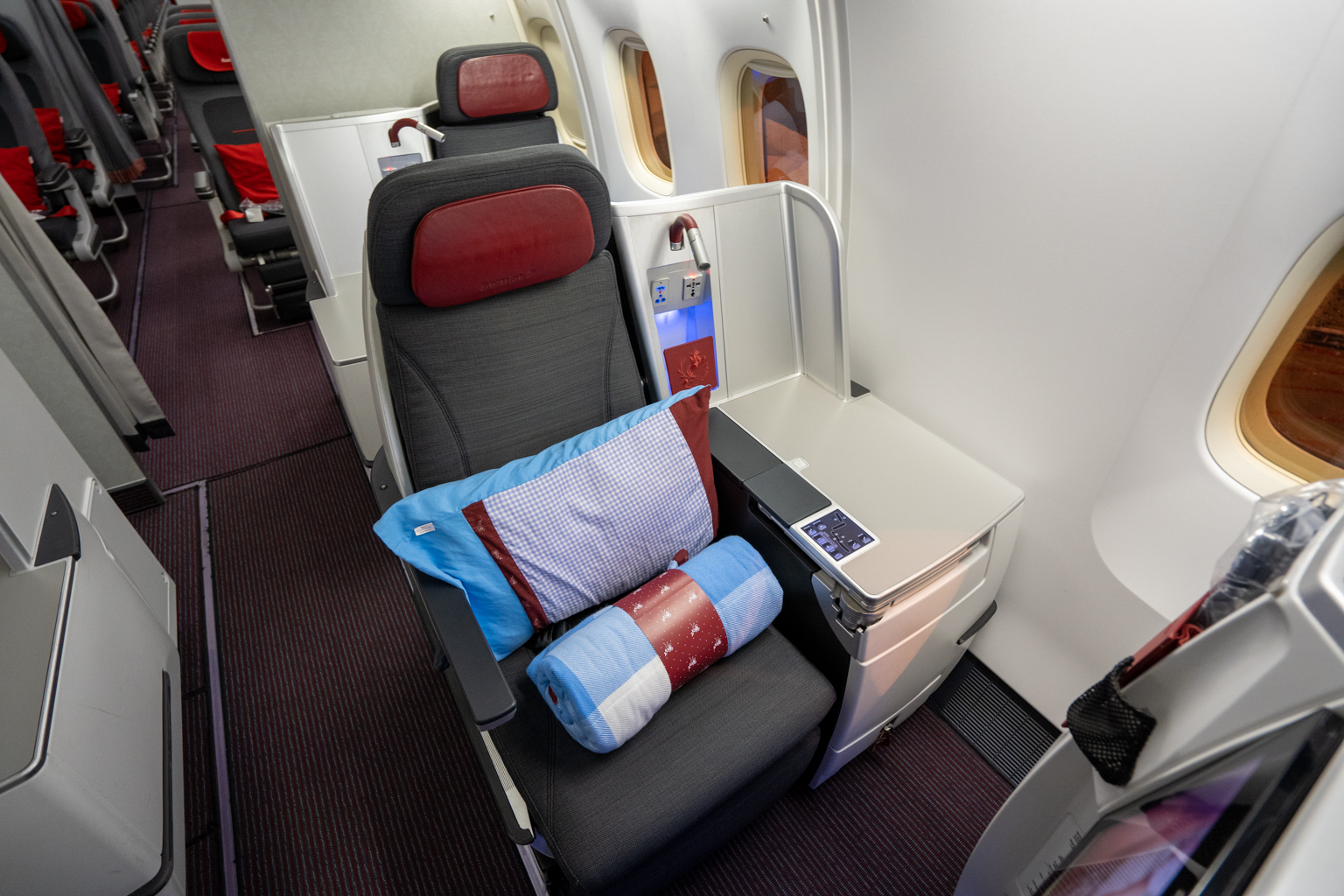
The 767-300ER carries 26 Thompson Vantage seats in a 1-2-1 staggered configuration across seven rows. The product is functionally similar to the 777's 1-2-1 rows – same seat type, same staggered layout with window seats alternating between closer to the window and closer to the aisle.
The 767 has the advantage of a consistent 1-2-1 layout throughout (no 2-2-2 rows), making it a more predictable experience than the 777.
Austrian's three remaining 767s are being retired as 787-9 deliveries continue. Originally scheduled for retirement by end of 2025, the timeline has extended into 2026 due to delivery delays. The Washington–Dulles route is expected to be the last 767 service.
Austrian Airlines Business Class Routes from Canada
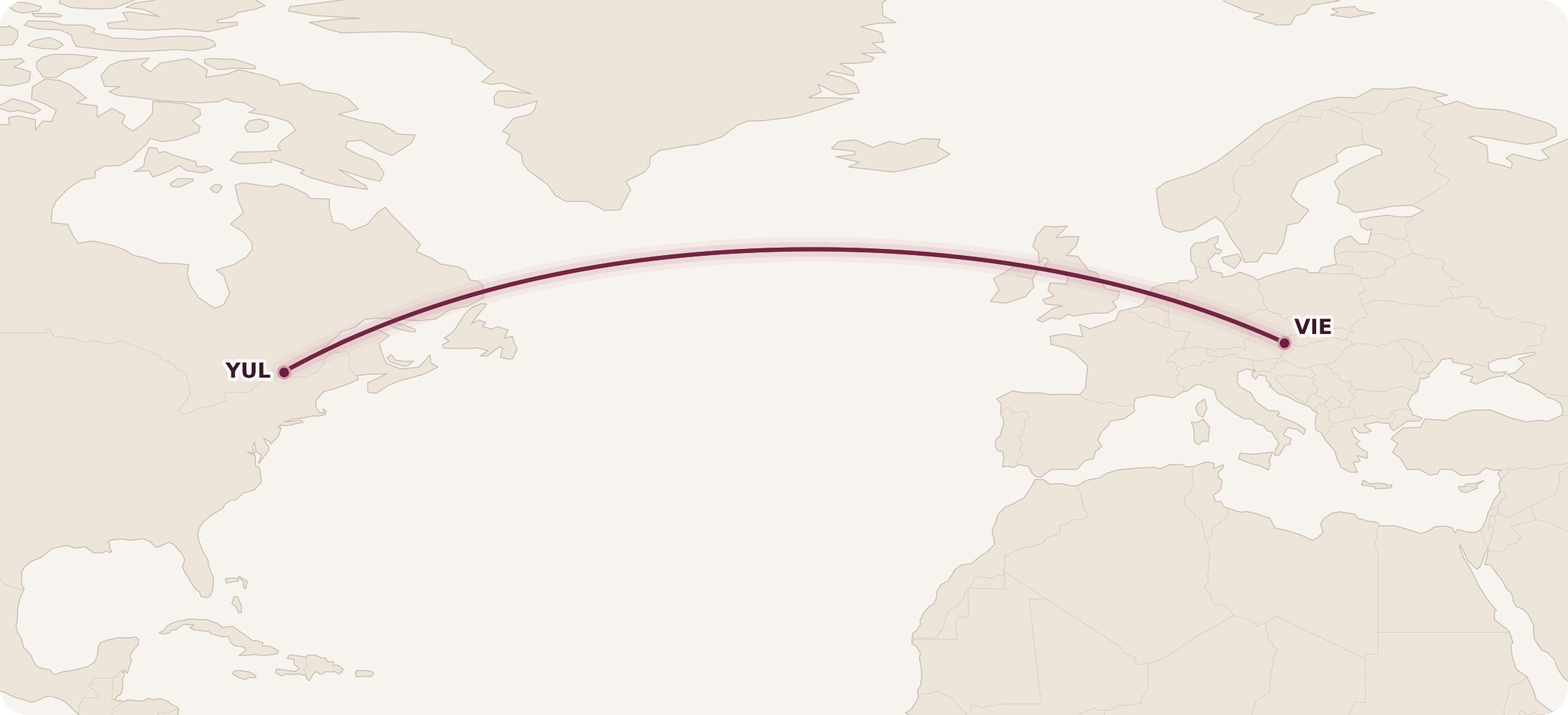
Austrian serves one Canadian city with direct flights to Vienna.
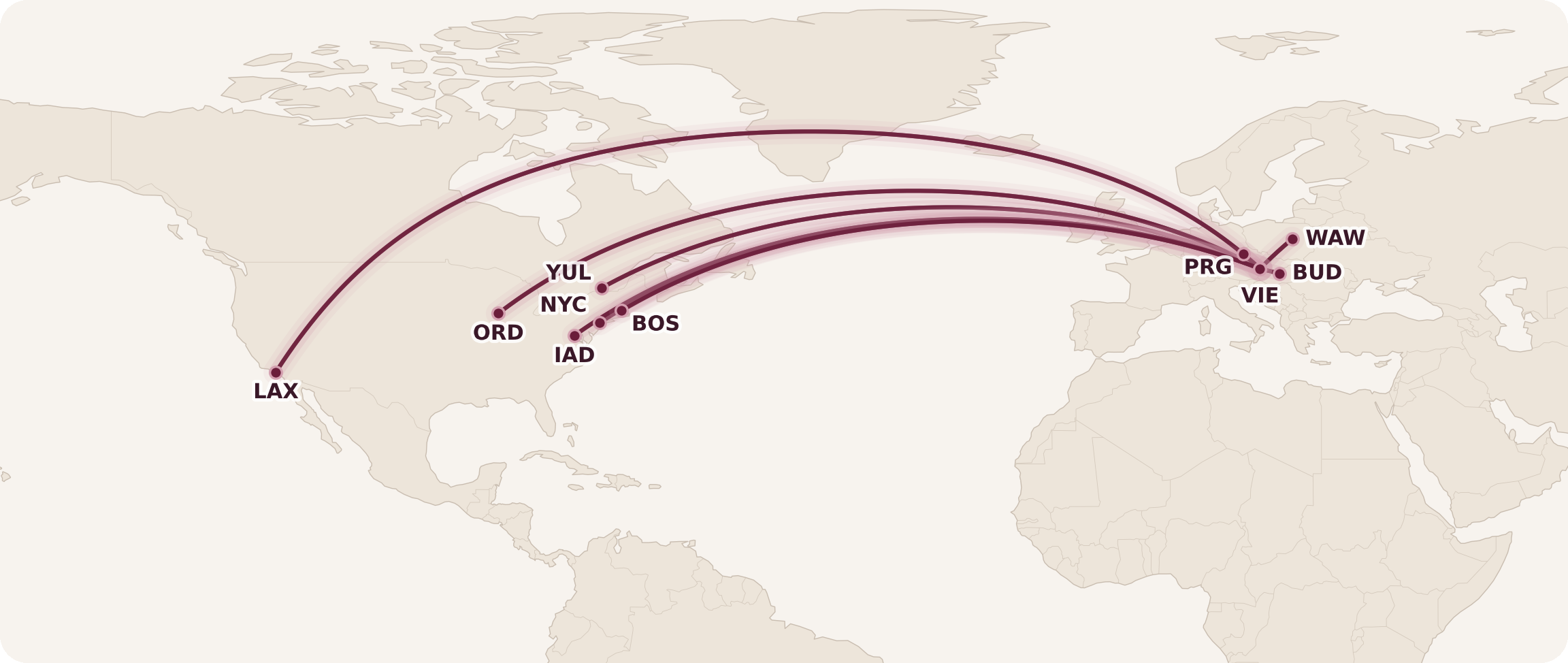
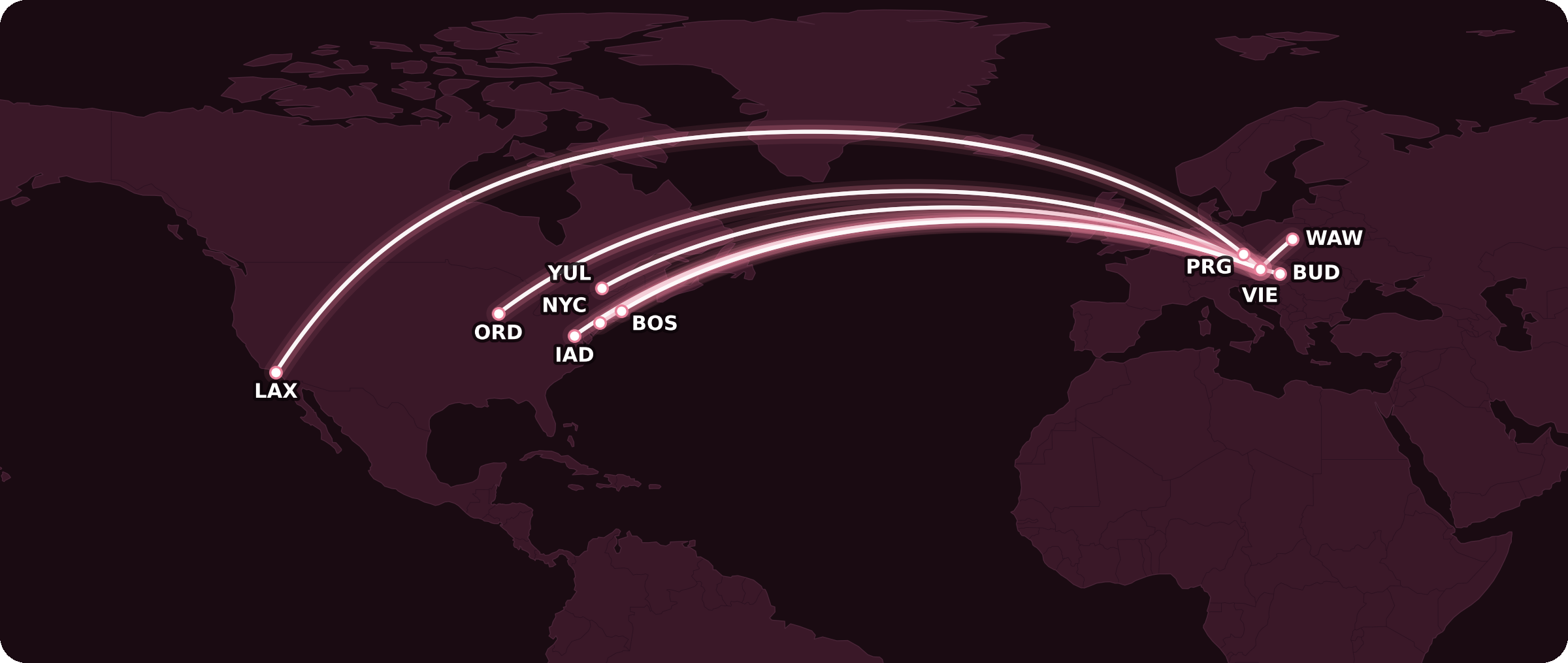
- Montreal (YUL): Approximately five weekly flights to Vienna, seasonal service. The route is operated by a mix of 787-9 and 767 equipment, with the 787-9 becoming more common as fleet deliveries progress. Check the aircraft assignment when booking – the 787-9 is a meaningfully better experience.
For Canadian travellers outside Montreal, Austrian is accessible through Star Alliance connections.
Fly Air Canada from Toronto, Vancouver, or other Canadian cities to a European gateway, then connect to Austrian's network through Vienna – or use Aeroplan to book a multi-carrier itinerary combining Air Canada and Austrian segments on a single ticket.
Vienna is an underrated connecting hub. Austrian's network radiates across Central and Eastern Europe – destinations like Budapest, Prague, Warsaw, Zagreb, Bucharest, and Sofia that are difficult to reach nonstop from Canada.
The airline also operates long-haul service from Vienna to destinations across North America, the Middle East, and Asia, though the European connectivity is where Vienna truly excels.
Key routes from Vienna include:
- Central and Eastern Europe: Budapest, Prague, Warsaw, Zagreb, Bucharest, Sofia, Belgrade, Kyiv, Tbilisi – extensive coverage of a region where other Lufthansa Group hubs offer fewer options.
- North America: New York, Newark, Chicago, Washington, Boston, Los Angeles, Montreal – giving Canadian travellers multiple options for positioning if the Montreal direct isn't available.
- Middle East and Asia: Select routes complementing the Lufthansa Group's broader network.
How to Book Austrian Airlines Business Class with Points
Austrian business class is one of the better values in Star Alliance for award bookings, thanks to zero fuel surcharges through several major programs.
The key advantage over booking Lufthansa or Swiss: Austrian tends to release more partner award space than its Lufthansa Group siblings.
Through Aeroplan
Aeroplan is the most natural option for Canadians. Austrian business class from Montreal to Vienna prices at 70,000 Aeroplan points one-way (fixed partner pricing, not dynamic), with zero fuel surcharges – only minimal taxes and airport fees of approximately $100–$150 (CAD) total.
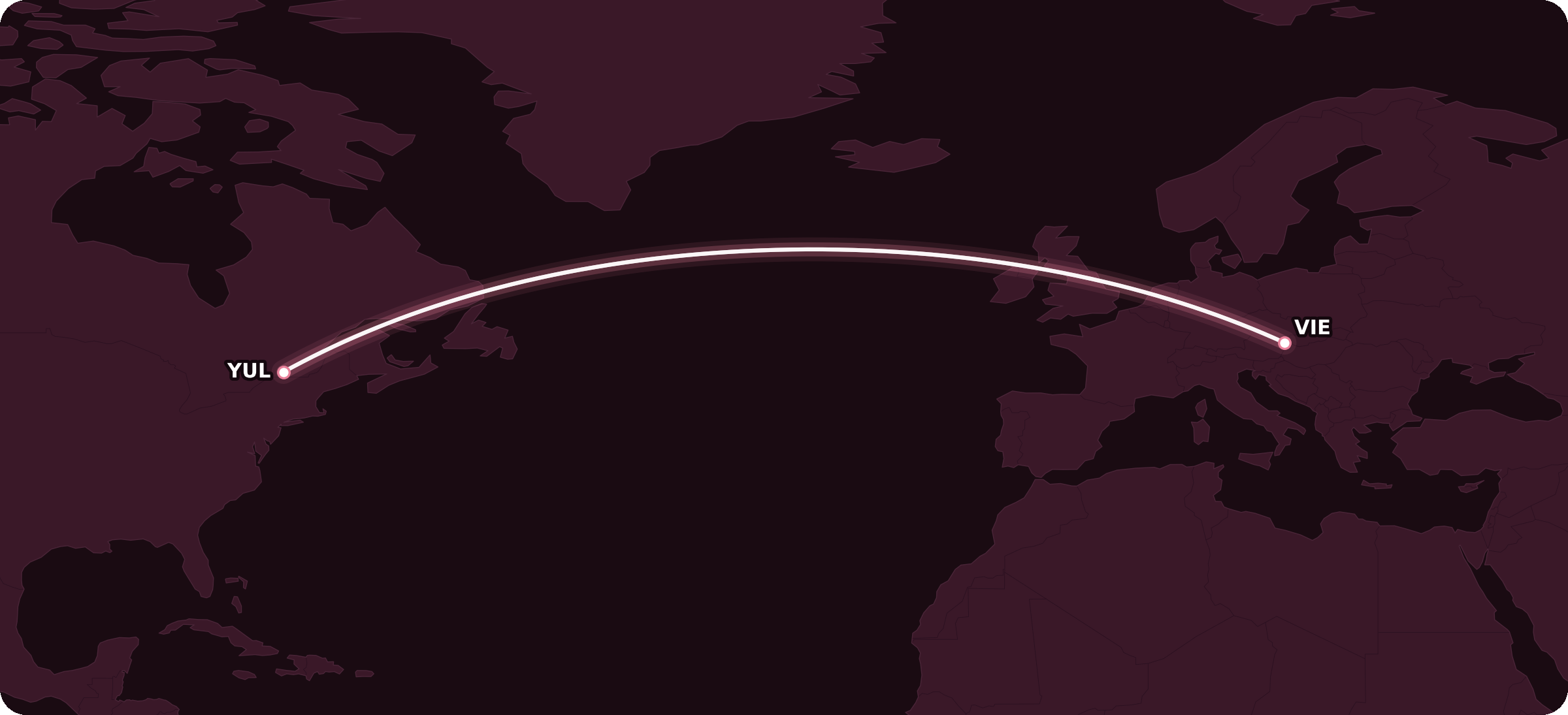
This is dramatically cheaper out-of-pocket than booking Lufthansa through Aeroplan, where surcharges can add $400–$800 (CAD).
Aeroplan points are straightforward to earn through Amex Membership Rewards transfers (1:1 to Aeroplan), TD Aeroplan cards, and CIBC Aeroplan cards.
Aeroplan also allows stopovers on one-way awards for 5,000 extra points – meaning you could stop in Vienna and continue to Budapest or Prague on a single award.
Through Avianca LifeMiles
LifeMiles is an excellent alternative, pricing Austrian business class from North America to Europe at 70,000 miles one-way with zero fuel surcharges. Total taxes are typically just $30–$50 (USD) – even less than Aeroplan.
The Brain's sweet spot data specifically notes that "Austrian often releases more partner availability than Swiss," making LifeMiles a reliable option for this airline.
For Canadians, the challenge is that Amex Canada does not transfer to LifeMiles directly.
The primary path is purchasing miles during LifeMiles' regular bonus sales (typically 50–100% bonus every 4–6 weeks), where the effective cost can drop to approximately $0.013 per mile – making a business class award achievable for roughly $960–$1,010 (USD) in total cash outlay.
Through United MileagePlus
United MileagePlus offers the lowest mileage cost at 60,000 miles one-way for Austrian business class (saver level), with no fuel surcharges. The total out-of-pocket is minimal taxes only.
Search and book directly on united.com – Austrian availability is generally visible through United's search engine.
The drawback for Canadians is limited access to United miles. No Canadian bank program transfers directly to MileagePlus, so you'd need to earn through flying, transfer from a US-based program, or use Marriott Bonvoy transfers (at a poor ratio).
Through Miles & More
Austrian's own loyalty programme, Miles & More (shared across the Lufthansa Group), is generally a poor option for transatlantic bookings. The programme levies substantial fuel surcharges of $400–$900+ (CAD) per direction on Austrian awards – eliminating the cost advantage that makes Austrian attractive through other programs.
Avoid for this purpose.
Austrian Airlines Business Class Award Availability
Award availability on Austrian is one of the airline's strongest selling points. Austrian releases generous business class partner space – more so than Swiss and often more than Lufthansa. Multiple dates frequently show two or more business class seats at saver pricing, even during peak summer travel.
For the best chances of finding space:
- Book early. Availability is generally best when the schedule first opens, roughly 330–355 days before departure.
- Check close-in. Austrian releases additional award space approximately 2–3 weeks before departure, making last-minute bookings viable for flexible travellers.
- Search on united.com. United's website is the most reliable tool for searching Austrian award availability. Find the flights on United, then book through Aeroplan, LifeMiles, or United MileagePlus depending on your preferred currency.
- Look beyond Montreal. If the Montreal direct isn't available on your dates, check US gateways – Austrian operates from New York, Newark, Chicago, Washington, Boston, and Los Angeles, all potentially bookable on a multi-carrier Aeroplan itinerary with an Air Canada positioning flight.
Tips and Strategies
Here are the key strategies for getting the most out of Austrian Airlines business class as a Canadian traveller.
- Target the 787-9. Austrian's fleet transition is underway, and the 787-9 Dreamliner with its consistent 1-2-1 layout and Dreamliner cabin benefits is a meaningful upgrade over the 777. Check the aircraft assignment before booking – the seat map will show whether it's the 787 (26 business class seats, 1-2-1) or the 777 (40 seats, alternating 1-2-1 and 2-2-2).
- Book through Aeroplan for the best Canadian value. At 70,000 points with zero surcharges, Austrian through Aeroplan is one of the most cost-effective transatlantic business class awards available. Compare this to Lufthansa through Aeroplan, where the same points cost comes with $400–$800 (CAD) in surcharges.
- Use Vienna as a gateway to Central and Eastern Europe. Vienna's real strength is its unmatched connectivity to destinations like Budapest, Prague, Warsaw, and Zagreb. If you're heading to this part of Europe, Austrian via Vienna is often the most convenient routing available.
- Choose the throne seats on the 777. If you end up on the 777-200ER, the solo window seats in odd-numbered rows (1A/1K, 3A/3K, etc.) are dramatically better than any other seat in the cabin. These "throne seats" offer true privacy and direct aisle access. Avoid the 2-2-2 rows if possible.
- Don't miss the coffee service. Austrian's Viennese coffee menu is a genuine highlight – request an Einspänner or Wiener Melange before landing. It's a small touch that reflects Austrian's cultural identity and isn't available on any other airline.
- Fly ex-Vienna for the best catering. DO&CO catering with Flying Chefs is at its best departing Vienna. If your itinerary allows, consider structuring your trip so that your Austrian business class leg departs from Vienna rather than from North America.
- Consider Aeroplan stopovers. Aeroplan allows a stopover on one-way awards for 5,000 extra points. Book Montreal–Vienna with a stopover, then continue to a Central European destination – effectively two cities for a modest points premium.
Conclusion
Austrian Airlines business class won't win any awards for cutting-edge hardware – there are no doors, no suites, and the 777's alternating layout is a genuine weakness.
But the airline compensates with one of the strongest soft products in European aviation: DO&CO catering with onboard Flying Chefs, a signature Viennese coffee service, and the understated elegance that defines Austrian hospitality.
For Canadian travellers, the real value proposition is the combination of direct Montreal–Vienna service, zero fuel surcharges through Aeroplan at 70,000 points, generous award availability, and unmatched connectivity to Central and Eastern Europe.
As the 787-9 Dreamliner fleet grows through 2026 and beyond, the hard product will improve steadily – and the soft product is already there. Austrian may not be the most glamorous choice, but it's one of the smartest.
First-year value
$336
Monthly fee: $15.99
• Earn 1,250 points per month upon spending $750 per month for 12 months
Earning rates
Key perks
- Transfer to airline and hotel partners
Monthly fee: $15.99
• Earn 1,250 points per month upon spending $750 per month for 12 months
Earning rates
Key perks
- Transfer to airline and hotel partners